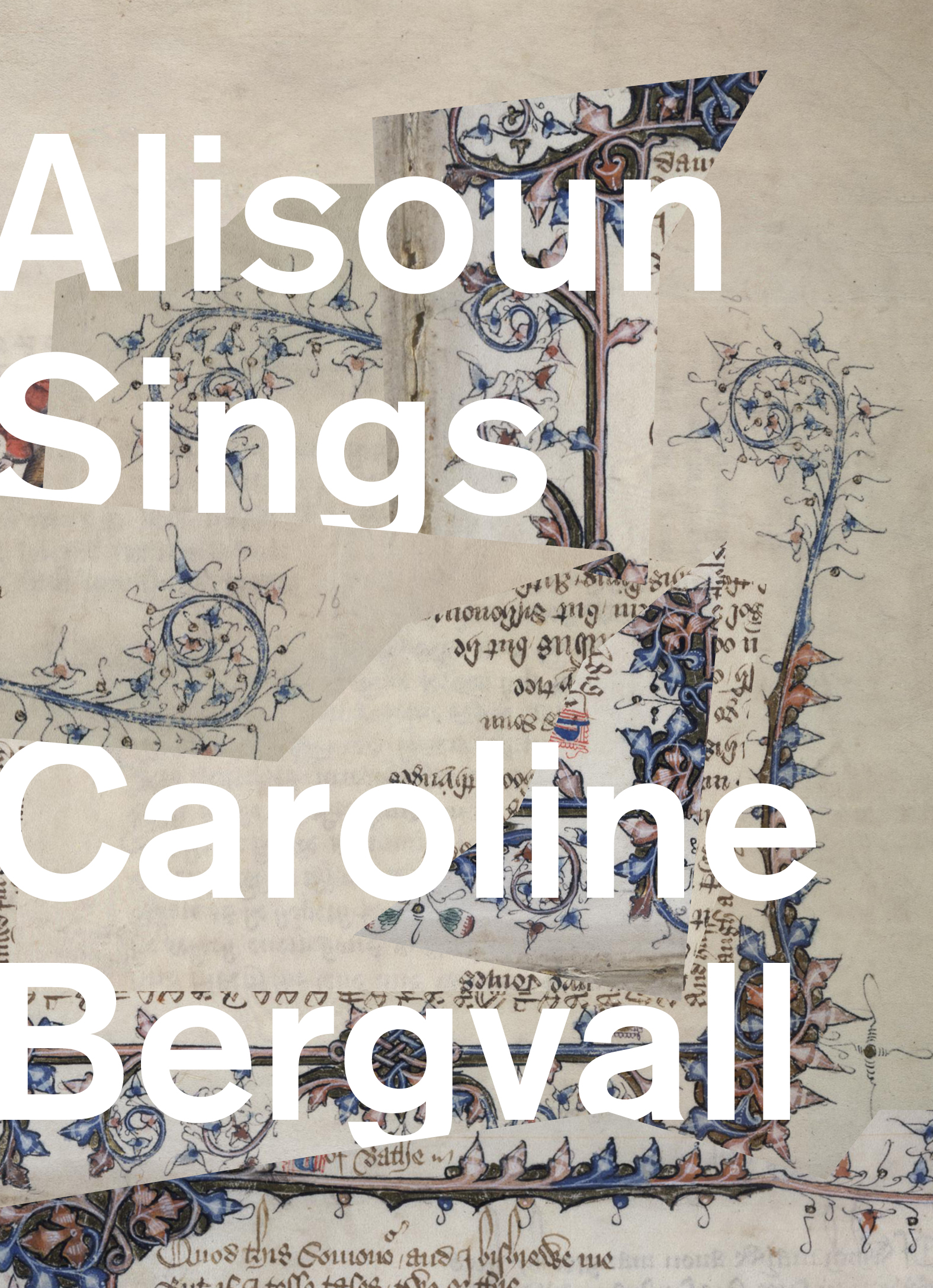
Alisoun Sings finds its starting-point with Chaucer’s iconic, proto-feminist Wife of Bath. Her forceful voice leads the way across narratives of gender, and addresses the brutality of social conventions with caustic humor. This labyrinthine text navigates love and protest in landscapes impacted by global warming, systemic violence and solar eclipses. Bergvall continues her previous work creating texts that rest on transhistoric forms of English, beyond its dominance as a global lingua franca, and places her quest in the intersections and migrations of stories and languages.
Reviews
There’s something echt modernist about Caroline Bergvall’s longterm project of turning over, repurposing, and generally fucking around with the western canon… Begvall’s Alisoun has the linguistic panache, the historical learning, and the theoretical chops not merely to rehearse a thousand years of oppression and resistance, but to offer in the poem’s final passages an infectiously uplifting — even for the cynical — call to arms.
The language evolves here, making Alisoun solidly in the forgotten and misunderstood past, while invading the present. This is a manifesto, an affirmation of identity, a recognition of a voice finally given shape.
Translation doesn’t have a resting point neither here nor there. But it spans that stretch. It comes across so many interactions. There’s no final mastery in translation because it’s taken over by the performative one way or another.
Clare Lees: What your work does for me is to pull forth the courage to be creative and critical, which is in fact what you do yourself.
Josh Davies: Could you say a little bit about your own relationship to the practice that Clare sketched out? What is the relationship between the creative and the critical?
Caroline Bergvall: To an extent I have called my work—also my performance or collaborative work that you see photos behind me circulating, and Alisoun is going to be part of that in the future—these interdisciplinary practices are also research led. In a way, my first motivation is to be looking at documents that can be from recent history or much older history, and then to start to find a way—how can I, or and why would I, reimagine or relocate this material into other contexts?
Bergvall turns ‘illegibility’ on its head: she insists on a poetics that is neither merely read nor impossible to read. Instead, Bergvall attempts to offer another way of being, necessarily multiple. This affords space for unknowing, for the unrecognizable, where political vision and perhaps even political intimacy and solidarity does not require immediate recognition within our normative configurations of the sensible and knowable.
Love binds, love connects. And through Bergvall’s ongoing commitments, those bindings and connections are explored thoroughly and beautifully. Closing the trilogy, finding the last poem, contains a bit of heartache, a sighing wish for Bergvall to continue. But, in fact, I won’t be surprised if that’s indeed what happens, if Bergvall finds yet another extension to this ongoing work. As Alisoun says in the book’s final poem, “The era of ma tellings nat bygone, just bigonne.” As symbol, as voice, as voices, there is much yet to read, many more moments to listen.
If we cluster, grow broader, aggregate, say yes to both ourselves and the needs of those outside our own immediacies, Alisoun suggests that we will be in good company for the work of pleasurable, collective living.
Resounding. Re-sounding. Resonance is the name of the game Caroline Bergvall presents in all those language games she plays seriously, and serially, more than totally.
Read the Q&A here
Across her trilogy, Bergvall’s hystoricism has made it possible to imagine and occupy such strangeness—to move in a poetics and politics where “the fever and collected energy” of popular protest extends deep into the past, involves its fighters, fast-talkers, and wanderers.
Alisoun Sings offers a radical approach to the dramatic monologue.
While preserving the basic integrity of a single voice, it fashions a communal
female voice based on literature (and songs) across centuries – but with
“Alisoun” and “Caroline” at its base. The resulting voice is fluid, queer,
sexualised, angry, ecstatic and self-reflective.