Praise
“Whatever lets in arborescent grammar” states Jay Gao in this startling and haunting fusion of the arboreal and the linguistic. This book not only lets it in but has invented it—and brings so much else into the mix along the way. There’s something of the ancient aphorism in the tone of these precise, at times even terse, lines that turns them to wisdom, but so unexpected are their phrasings that we gradually realize that this is wisdom in the making, making itself new again right before our eyes and in our minds. A tour de force of unprecedented form and thought.
-Cole Swensen
Pursuing “the intimacy of two words who share a sound,” Jay Gao plumbs the suggestive slippage between clonal and colonial, vernal and venal. His sly slant rhymes and critical glitches document the kinds of (un)likeness endemic to empire’s “relational field.” Attuned to its “lyric violence,” Gao countersings the racialized subject while equally attuned to the eros of language at the level of the morpheme. Sensitive “to the microclimate on someone else’s skin,” his sensuous intelligence also attends to “Whatever lets in arborescent grammar.” This brilliant, ambitious book deepens our listening to the social ecologies of the present.
-Brian Teare
Etymologically, Paradise might be a walled garden, a place with limits—but a poem is forever. Like Inger Christensen’s Alphabet, and Aimé Césaire’s Notebook of a Return to the Native Land, Gao’s The Dead One is both a lyric feat and a techno-herbarium, resourceful and delicate as a seed. Not a poem that includes history but a poem that resists enclosure, and thereby bears futurity.
-Joyelle McSweeney
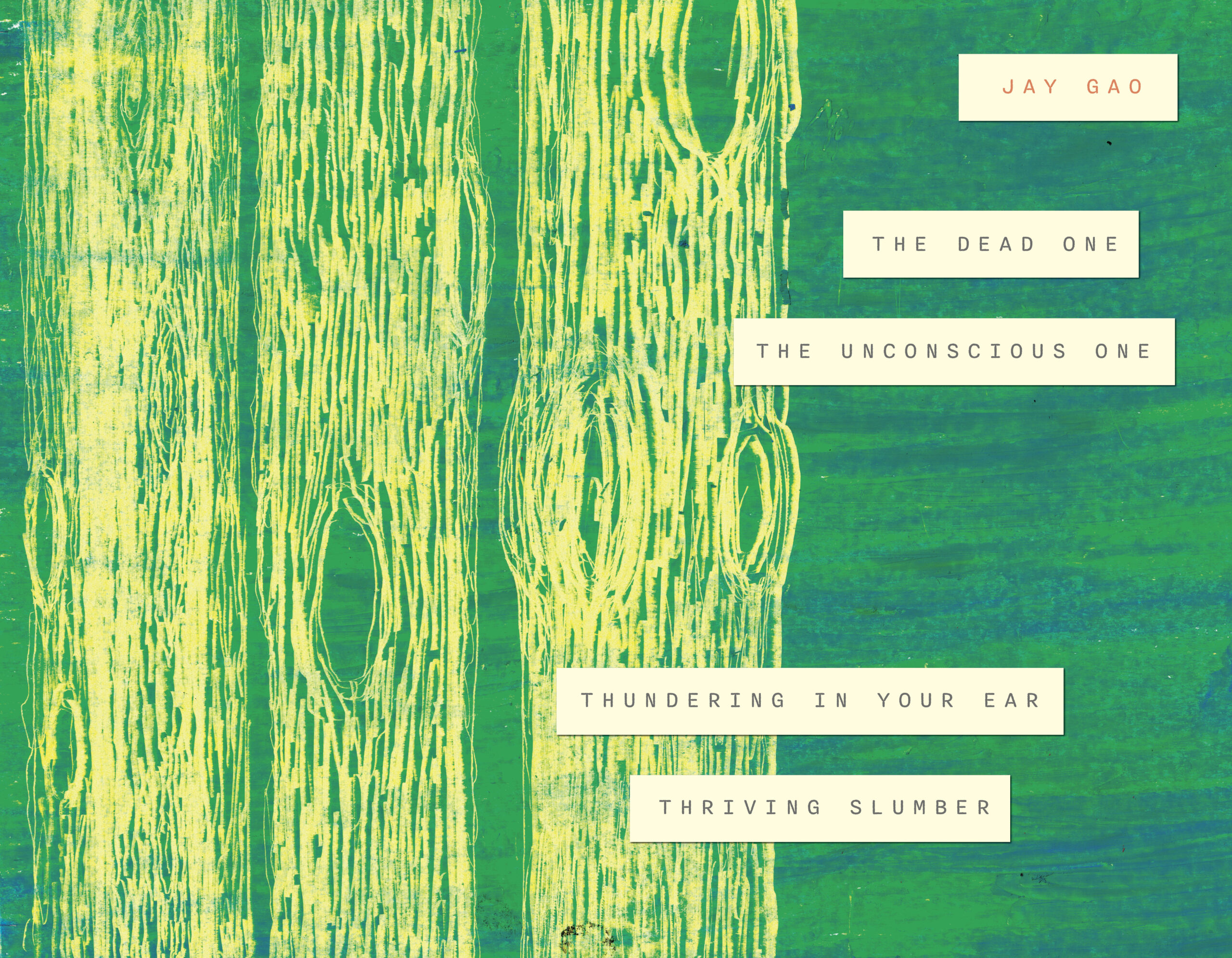
How do you read a book that is falling apart in your hands? Jay Gao proposes the sentence as something rotting and churning: a “fungal shimmer.” In The Dead One, The Unconscious One, Thundering in Your Ear, Thriving Slumber, mud and flesh are evoked in configurations that illuminate the moment when “earth gives way.” Fieldwork, in Gao’s second collection, is a mode of dissolution that collapses and distends the boundary between skin and splinter, bark and archive. As Gao writes: “. . . have you seen enough.” There’s no question mark. How do you write a book that breaks off, that stops being written, in the middle of a sentence that is also a line?
-Bhanu Kapil
Jay Gao’s necropastoral epic creates, through its branching, accumulating lines, a vast linguistic commons where time, ecology, and eulogy are inextricable. These “glitch woods” / words splinter open, revealing the detritus and pulp of ecocide and colonialism inside our land and language. A text that, like an organism, seems to write and encode itself inside “marsh time,” The Dead One dwells between rot and balm, corpse and copse, plot and plot. This is a gorgeous fieldwork, a rewilding, a poem unlike any I’ve wandered through before. I think I fell asleep somewhere on one of its many lush paths and never quite left. I live here now.
-Emily Skillings
Is it possible to replace one’s nervous system with a book? I would choose this one. Jay Gao’s The Dead One, The Unconscious One, Thundering in Your Ear, Thriving Slumber is a hypnotic, haunting articulation of queer ecopoetics felt beneath the skin, in scavenged “leaflight,” in dappled lengths of line. Here, we learn from the forest as psycho-poethic imprint, as process archive of retractions, failures and impossibilities, as intimate gathering, as sensory encounter, “shared breath.” Words are deeply material units: shedding, squandering, spreading. With elongated lines, repetitions and slips, The Dead One recalibrates lyric as a necropastoral codex. Gao offers instances, dispersals and lists, fostering a canopy of arboreal abyss and bliss. This is a poetics of transfiguration, of difficulty, entanglement, grift and splinter: “a scream” turned “into ink,” a performance score for becoming-tree, an enquiry into “time-adjourned being” and desire’s “erogenous pollen.” I am in love with its disorientations, its fluent gorgeousness, its clarity, abundance and play.
-Maria Sledmere
“Imagine an intimate talking that takes place across an impossibly prolonged time,” as Jay Gao asks us to, and you get a sense of what it’s like to read this exceptionally beautiful long poem. Constructed out of gorgeous arboreal jargon and “provisional divine chit chat,” every page of this sprawling work flashes with “lariat[s] of pinprick recognition.” It’s an “ecological tantrum,” a medieval dream vision, a catalogue of many different things life contains, bound together in and by their “otherhood.” What holds these various elements together? Or, to put the question in Gao’s terms, “What’s the anti-matter”? The response this poem offers is “Love.”
-Oli Hazzard


 Intergenre, Essay, Poetry
 Poetry
 Poetry
 Translation, Essay