
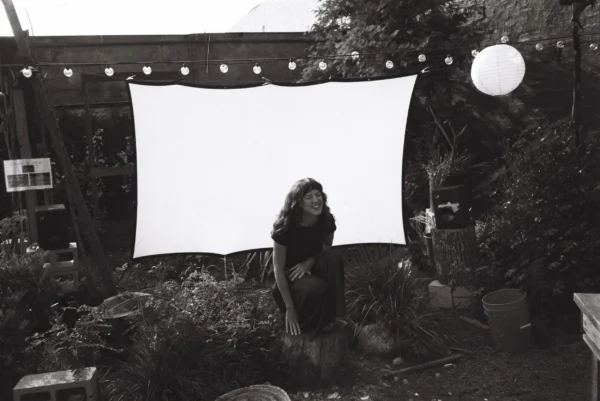
Sophia Dahlin’s new book, Glove Money, out today from Nightboat, is a collection of love poems that originates from the dating show of your own design: “I felt that dating lots of beautiful women might be the solution to all my problems” and transitions to that deeply meaningful place where you start to fall in love, “when you are grasping piecemeal the person that’s about to come in and rewrite (and be rewritten by) you.”
Sophia Dahlin talks about love poetry, the term “sapphic,” how to make lesbians angry, and whom she writes for: “Being gay doesn’t make you good, it makes you a pervert, and that’s much more fun.”
—Lina Bergamini
Lina Bergamini: You work from within the rich tradition of the love poem and described this book as coming from “the fantasy and terror of erotic love” and “selfishness of desire”—how do the poems in Glove Money work for and against the trope of the love poem?
Sophia Dahlin: I think—but I’m open to dissent— that the poems in Glove Money surrender utterly to the tropes of the love poem. Sapphic cuckoldry, troubadouresque complaint, Hafezian braggadocio, Shakespearean discourse on the metaphysics of the lover’s eye . . .
There are so many kinds of love poem in it—the kind in which the lover describes themself, their suffering and pleasure; the kind in which the poem exalts the beloved; the kind in which the lover eats pasta and gloats over a bed’s postcoital deshabille…and there’s another kind—what’s it called when Sabrina Carpenter says “you’ll just have to taste me/when he’s kissing you”? The kind of love poem in which the lover posits themself, god or ghostlike, as a permanent permeating force in the life of the beloved. The egoistic fantasy that if I (to put it demurely) kiss someone, they stay kissed.
Lina Bergamini: Do you want to talk about the circumstances that led to writing Glove Money?
Sophia Dahlin: Most of Glove Money was written before 2020. There were some years in which for various reasons discernible and indiscernible to me I felt that dating lots of beautiful women might be the solution to all my problems, which did turn out to be true, eventually, but for a while was primarily a source of new problems, as love always is.
In that time I was also attempting to write a book of “sapphics” with a friend, a term we never defined, but which quickly turned out to mean two different things. For her, it meant the clitoral. For me, that’s a fun fetish, but not necessarily related to sapphism. When I think of Sappho, I think of the romantic passion for her lovers, the fascination with her own power and powerlessness, and the historical presence of a crowd of women around her, listening, learning, and creating together. I also think of lesbian sex, of course, but I don’t think of the clitoris as an essential component of lesbian sex. I wrote several poems arguing this before the project had to be scrapped due to a related but worse issue I won’t go into here.
At some point not long after I fell badly in love with my girlfriend, Violet, which presented me with a whole new set of sapphic problems. Thus there’s a specificity that emerges through the dreams and nostalgia and flirtation and hypotheticality of the other love poems of Glove Money. The work I’ve written since then is full of Violet’s personality and our conversations, but Glove Money is imprinted with the glimmering outline of an earlier love, what Violet has called “a set of eyelashes coming over the horizon,” the way it is when you are grasping piecemeal the person that’s about to come in and rewrite (and be rewritten by) you.
Lina Bergamini: You teach poetry workshops. Do you feel that your teaching influences your writing?
Sophia Dahlin: Oh surely. I wrote a lot of these poems in class, while my students wrote. I wrote let’s see—at least 8 of the poems in Glove Money in workshop. I am often teaching different forms, either traditional or lifted from a single poem (every poem implies a form) or “invented,” to give my students new ways into writing. On my own I would probably take the same way in every time—listening to phrases forming in my head until they start to make a sound—but I think it’s better for my writing to change it up. Plus, teaching is a joy—it’s one of the ways I write in community, and writing in community almost certainly contributes to the playfulness of my work and the sustainability of my practice. I advise all poets to write together, too, whenever we can.
Lina Bergamini: Is it “more lesbian culture to be bi than lesbian”?
Sophia Dahlin: I figured out at some point that saying this pretty reliably angered my friends in lesbian relationships—most of whom identify as bisexual—and so I kept saying it, for the joy of argument. Our community can get a little pious, and piety about sexuality is silly, as if lesbianism were an enlightenment rather than a horny compulsion. Being gay doesn’t make you good, it makes you a pervert, and that’s much more fun.
I admit to being something of a skeptic of monosexuality. Bisexuality is a proven phenomenon—it can be observed at a single house party—but monosexuality is impossible to observe in nature. It would take careful observation of an individual over the course of a lifetime, as well as total cooperation and introspection on the part of the subject—we just don’t have the funding for that.
Lina Bergamini: You have described this book as “Sapphic” and “Lesbian”—what is your definition of those words?
Sophia Dahlin: To me, the terms “sapphic” and “lesbian” are two interchangeable terms that describe women’s erotic and romantic love for other women. You’ll notice this definition does not limit lesbianism to lesbian women—a bisexual could get in there too—but it does limit it to women. However, I imagine someone who doesn’t identify as a woman could experience a love that feels lesbian to them, and I wouldn’t argue against them. To quote myself, sorry—we’re not going to have standardized gay vocabulary unless we all lose. A lot of the poems of Glove Money can be read as engaging terms that mean different but related things to people who are speaking to one another, and who understand one another, and who take up the other usage while persisting in their own. “Queer,” “lesbian,” even “pussy” come up in this way. In the poems, I use them to mean what I mean, and also what you mean, and keep those usages in conversation without conflating them. This isn’t a special poetic trick—it’s something we do in conversation all the time. We don’t need standardized queer vocabulary to be mutually intelligible. In fact, we’d understand less.
Lina Bergamini: Is love a source of new problems or the solution to all?
Sophia Dahlin: Yes!