
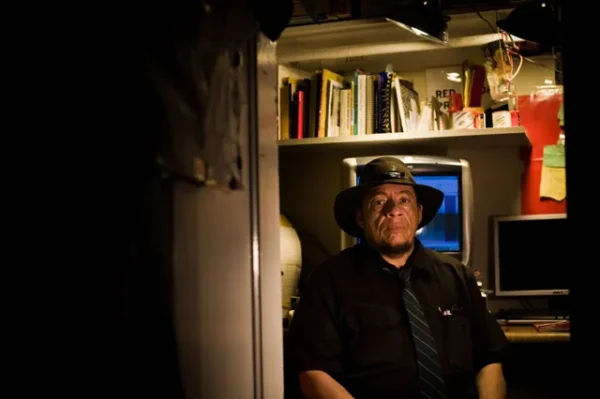
The following is Michelle Tea’s foreword to Red Jordan Arobateau’s Time Also Will Make It Interesting: Selected Journals, edited by Cameron Awkward-Rich.
I was on my way to interview Red Jordan Arobateau for the San Francisco Bay Guardian, my editor having accepted my pitch for a profile of this incredibly prolific, underappreciated writer. Did Red really live in Nob Hill—Snob Hill, as it was often derided? This seemed incorrect, but maybe I was wrong about Nob Hill? In my mind, Red was a type of queer Bukowski, for his lustiness, the way he claimed getting off as a sort of animal birthright. His experience of class makes Bukowski’s working-man schtick seem aristocratic, as Red’s multi-classed experience included the criminal class, that anxious category occupied by so many transpeople, or any queers whose gender presentation makes the boss man’s knees quake. Like Bukowski, Red was madly prolific; like Bukowski, he attacked his typewriter in small, low-rent rooms, producing an abundance of text, an electric hypergraphia surging with a need to get this life, this fucked-up gorgeous inspired suffering holy erotic ecstatic oppressive communal life, as lived by him—all his actions and reactions and situations and yearnings and failures and efforting—get it all down, all of it, and not just that stuff but also the thoughts such experiences bring, the conclusions you arrive at and the philosophies you create. And then, the larger landscape, the backdrop this one precious life is backlit by. It’s all there in Red’s writings, most illuminatingly in this, his personal texts.
It was a beautiful, sunny day in San Francisco the day I went to Red’s apartment for the interview. I understood him, this person walking among our literary and queer communities who was actually quite possibly a genius of sorts, suffering the very specific wound one gets from being a genius within a society that believes, no, such a thing could not be true about you, for how could a low-rent criminal mixed-race transdike be a genius? Red had survived eras I had only read about in books by Lillian Faderman and Leslie Feinberg. Red survived bar raids and mafia-owned lesbian bars, survived adopting butch as the closest linguistic approximation to his interior, survived eras of lesbian political organizing and its minutiae of oppressive social codes and infighting. He lived to see and become part of a true trans revolution, gaining a crucial—life-saving?—context for himself. Despairing at how he might live to one hundred in his body’s disjuncture, he begins to take testosterone on the Fall Equinox, mindful of both the significance of the pagan marker of transition as well as the metaphor for a later period in a human’s life. Mindful, too, of how a new relationship with needles harkened back to the sex and drugs and criminality of his earlier years. When a windfall of cash, the result of a forgotten legal squabble, dumps thousands of dollars into his life, Red uses it to fund his top surgery, no matter if his wife thought the money was best spent on food—she was, after all, “not trans; just a lezzie.” She couldn’t know, but Red not only knew, he believed—in himself, his voice, his needs, his experience, in what looks like a hot light within him. “I have this crazy energy,” he wrote. “It just keeps driving.” It drove him forward into his destiny, to write and write all of this life down, with a wild trust that maybe, if it didn’t seem to mean very much at the time, maybe it could mean something in the future, and here we are. Writing about himself in the third person, a great way to express the sense of self as an actor in the great movie of time, Red typed, “He was one of that rare race of people who is loyal to the urgings of their soul.”
There I was at Red’s place in Nob Hill, and it wasn’t snobby at all, of course it wasn’t. I think if you kept climbing higher it got a little tony, but Red’s spot was literally upstairs from the Nob Hill Theater, a notorious male strip joint. Cable cars, relics from another era, clanged nearby, solidifying a sense of Red as a creature out of time, perhaps composed of time itself. His apartment was small, I remember it felt almost too intimate to be in such snug and lived-in space, but his animals broke the ice, a shaggy dog and a bird in a cage. I don’t remember what we spoke about, and the article seems to be lost to history, but it’s easy to remember Red’s chiseled face and his thick brown hair pushed greasy from his creased brow, his sideburns and whiskers, always dressed in black, black western shirts, black jeans, and his sharp, intense eyes. He was a Scorpio, the most intense of signs, ruled by Pluto and sex and death, Big Shadow Energy. His Mercury was in Scorpio as well, and so he was compelled—it had to have felt like compulsion, you can feel the pulse of it in his work, driven by his crazy energy, a force as muscular in his life as libido—to communicate all of this sex and struggle, and transformation, for Scorpio is the sign of the zodiac with the greatest potential for transformation. Red’s Venus was in Libra, hence in love with love, but with this heavy Scorpio/Plutonic influence is built a person in lust with lust, and able to convey the romance of that—the outlaw romance of hungry bodies at odds with the world, coming together explosively, maybe desperately, and isn’t that romantic, too? “The thrill of pure sex. A walk on the wild side.”
Red was married for many years, which is very Venus in Libra, as is his melancholy realization that so much focus on a raw and clawing erotics had left him ignorant of—bereft of—the deeper, more languorous pleasures of kissing—“But what do you expect of a person who first learned to make love in a public toilet?” Red’s Moon and Mars were in the hyper-intellectual sign of Gemini, perhaps the source of his “crazy energy,” giving him a true need for cerebral stimulation, a need he both generated and satisfied, a one-man Tesla coil, as Gemini placements suck cosmic mental energy from the ether, bringing pure communication into their bodies and optimally processing it through language and other forms of communication—writing, fucking, philosophizing, painting, caring, drinking, drugging. The moon is the sphere of emotions, how one feels and what one needs to feel whole and safe, while Mars is how we fuck and fight, plus where we store our ambition. That Red both felt his intellect and intellectualized his emotions is clear in his work, and Mars in radical Gemini made sure he knew he was a genius, and understood that it was the dirty world—capitalism and the divisive hatreds it encourages in humanity, Ginsberg’s Moloch—that kept him from accessing the material pleasure and comfort such genius could bring.
I remembered being on tour with Sister Spit in 1997 and reading Leader of the Pack, his dike biker novel, clutching the pulp of it in my hands, it was night and we were all being put up on lesbian land in the South, outside Charlottesville, Virginia. It was a real page turner, I was shot through with inspiration that this person was in our community. I invited Red to be in readings and shows, and wrote about him sometimes. Red was a little difficult in that because he’d been nurturing his genius against the odds for so long, if someone showed interest it could trigger a frantic grasping for more, as if this was the opportunity that would bring his ship in. He seemed to not understand that we were all out here desperately gripping for opportunity, and it seemed to illuminate what a lone wolf he really was—interested in community, as shown by his faithful participation in the FTM meet-ups that brought him so much context and understanding, but ultimately outside it all. In the world, but not of it. But I also understood the fumblings of his ambition, like an eager, oversized puppy never allowed to grow into the size of its paws. He’d been at it all so long, so much potential had already been lost to time’s passage, surely he felt his mortality, that youth had become one more part of society he’d been cast out of. Like every single queer artist ever, he was ahead of his time, and he knew it, and it hurt—we know it, and it hurts. Though one cannot ever really be ahead of one’s time, can we? Every time requires queers like Red, to live like Red did, in ways that are hard and unfair and scandalous and insatiable, children of Mercury tasked with taking cosmic dictation, recording it all for its own onanistic pleasure, and for the sake of us readers and queers and trans folx, infinitely, through time, needing the comfort and pleasure and guidance of his life, how to go on, as he did, through dark times, lit from within with sex and art and writing, with a tough wonder. “Life is a self study,” Red wrote. “We have to dig deep for this study and push it to the end.”
—Michelle Tea