
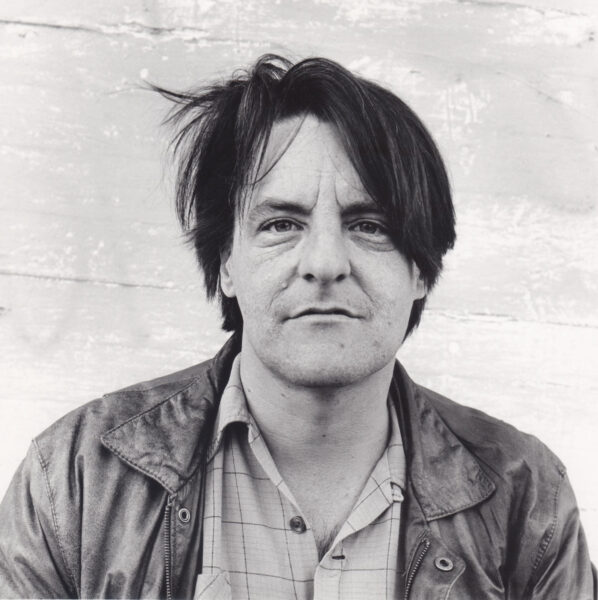
The following is excerpted from Kay Gabriel’s introduction to Kevin Killian’s Padam Padam: Collected Poems, edited by Jason Morris and Evan Kennedy.
Here’s a story from Kevin Killian’s memoir Bedrooms Have Windows, in a chapter titled “Poetry.” He goes to a reading in New York by the poet Ted Berrigan and discovers he doesn’t understand Berrigan’s writing at all. In response to what feels like humiliation, Killian steals first the hors d’oeuvres, then the wine, then “hundreds of pills—probably Ted’s also . . . it was like Valley of the Dolls.” Then the youthful Kevin Killian hits the road and travels, cowboy style, west to California, leaving New York behind for good.
I’d be surprised if anything like that really happened. It feels instead like one of Kathy Acker’s fables about real, famous people, but with more allegory to it. (Some evidence: Killian says elsewhere that Berrigan, Ginsberg and Plath were his favorite poets before he moved to California and got involved in the New Narrative movement—more on that shift in taste below.) Decode the allegory: Killian steals outrageously from another to produce a totally different creative result. It’s never actually derivative, except in the most literal possible terms. Killian takes a title or a proper name or lyrics and puts all that to work in new and alien ways. In prose, in poets theater, and in his poetry, Killian practices Bertolt Brecht’s principle that repurposing familiar language, image, and encounter makes new consciousness possible. Is that grandiose?—have I gone too far for a body of work that collages B movies, advertising copy, and the lyrics of Kylie Minogue, that explicitly downplays its own seriousness? Forgive me, Kevin, I think it’s the truth.
In contrast to his fiction (Spreadeagle, Shy, the stories collected in Impossible Princess) and memoir (Fascination), Killian’s poetry more rigorously and thoroughly places a third term between itself and its object. To write Argento Series, his first book, Killian followed a suggestion from Acker to write about the catastrophe of the AIDS crisis in San Francisco through the horror films of Dario Argento. His second, Action Kylie, puts Kylie Minogue to work. Killian, both addressing and in drag as Kylie, borrows an insight from camp sensibility that total adoration makes its object more interesting and capacious. Similar principles of composition apply, in whole or in part, for the other books and chapbooks collected in this volume: Tweaky Village, Tony Greene Era, Elements.
Throughout these exercises in riff and quotation, Killian is almost always in drag: as Kylie Minogue as the Green Fairy in Baz Luhrmann’s Moulin Rouge, as a tweaker who “lost ME to METH,” as Frank O’Hara acting perfectly disgraceful, as Tim Dlugos intoning that “the corpses change but the party goes on forever.” The drag changes, sometimes, from poem to poem, or line to line—like, Kevin, you did it again! In the spirit of literary drag, Killian never means “I” straightforwardly when he says it, not even when the “I” really really is Kevin Killian. Playing these “city games”—a section title in Action Kylie that he pinched from a rumored but never released Kylie Minogue album—makes it possible for a reader, in her own drag as Kevin Killian, to encounter old problems, curiosities and terrors from new and productively strange perspectives.Think of it as an experiment in collective language, in which mouthing someone else’s words in a different context transforms the speech no less than the speaker.
[…]
What’s the cumulative effect of all this wild combination, what does it look like in practice, how did Killian even get there? While he bypassed the dead weight of gravitas that a lot of US poetry adopts by default, Killian also took poetry seriously enough for it to have the function of religion—in the sense of assembling a community dedicated to determining meaning in round after round of structured play and deliberate interpretation. Killian drew this lesson from, among other sources, the San Francisco poet Jack Spicer (1925-65), whose biography he co-authored with Lew Ellingham, and whose collected poems he co-edited with Peter Gizzi. A basically neglected poet when Killian and his collaborators worked on their books about him, Spicer combined his militant anti-professionalism with a profound faith in poetry as a vocation understood and experienced through dedicated, repeated, communal practice.
Spicer’s emphasis on the community that makes poetry function found a welcome audience in the Bay Area’s New Narrative movement, which Killian enthusiastically participated in nearly from its start, and whose writers collectively and individually emphasize the role of the social in artistic production. Killian and Dodie Bellamy in their introduction to Writers Who Love Too Much, their anthology of New Narrative, specifically compare New Narrative’s “writing prompted . . . by community” to Spicer’s “Poetry and Magic” workshop, “when [Spicer] was writing books in which every poem was written for a different person he knew.” Only where the coteries of the San Francisco Renaissance sometimes tended small and insular, Killian, bolstered by New Narrative’s pro-social ethos, magnanimously expanded the poetic community that he stewarded—through Poets Theater performances, reading series invitations, personal correspondence, editing others’ manuscripts. One could get drunk on his admiration, his warmth and support. With a thoroughly genuine attention and a mighty mental Rolodex, Killian made the people around him feel like the stars of stage and screen whose autographs he collected, as if he was your fan, and not the other way around. His tactfulness and generosity of spirit set an example: Killian treated poetry as a social infrastructure through which people can come to recognize each other as part of a shared project.
[…]
But I don’t mean to accuse Killian of all this weighty stuff, like revealing truth and transforming reality, without also crediting him for authoring a fabulous, permissive body of work, charming, filthy and smarmy at turns, with its retchable milk enemas and its devilish twists on Hölderlin’s “Pallaksch.” It’s as if he’s always stopping to say hey to some bright gem of cultural refuse, and figuring out how he can set it into his language palace. Thank God we get to live there forever, too. Like Brecht and Kurt Weill said about their Rise and Fall of the City of Mahagonny, Kevin Killian is fun. He’s more fun than you or I can bear, and we have to, have to, keep bearing his wit.
I don’t need anyone to copy Kevin Killian’s accomplishments, or adopt his dreams as their own, any more than one might attempt to recreate Kylie Minogue’s 1997 trip hop album Impossible Princess from scratch. Instead, look at what Killian made possible through his practice, his own particular discipline, his dedication to others, his voracious cultural and intellectual appetites. The stakes are so high, actually, for a queer culture that’s both fun, as in actually desirable to live in, and capable of thinking through crisis. Thank God—and thank Dodie Bellamy, Evan Kennedy, Jason Morris, and Nightboat Books—that his collected poems are now in print. The poems you’re about to read aren’t just some kind of bliss. They’re a master class in mediation. They’re queasy. They’re writhing off the page. And metabolized in your mouths and thoughts they’re about to live another life, and another.
—Kay Gabriel