
The following is excerpted from Anne Boyer’s introduction to Olivia Tapiero’s Nothing at All, translated from the French by Kit Schluter.
Translated with a fierce precision by Kit Schluter, Olivia Tapiero’s Nothing at All is an urgent, visceral meditation on dissolution. Tapiero’s nothing is hungry, moody. It gives birth, mutes the stars. It begins as a black hole—a cosmic riddle about claustrophobic emptiness. But the black hole has sisters: the difficult body, the sea, oblivion, the erasures of history. “If every galaxy has a black hole at its center,” writes Tapiero, “it is possible that every black hole contains a universe.” From this premise, the book itself emerges, born from an orifice that is both the source of this nothing and its frame.
This orifice is witness, and sometimes it is wound, or mouth, or cave, or aperture. It comes both out of the nothing and frames it. It is a sensate threshold where being convulses into form and form trembles at its own dissolutions. The orifice “vomit[s] the egg intact,” “vomit[s] eyes planets/ women’s riddled bodies,” expels and ingests with “irresistible viscosity.” Colonial, gendered violence is inflicted and resisted there, as the mouth, where tongues are severed, where forced assimilation turns to bile, where the body rebels by expelling what it cannot digest. Jealous gods give birth through their mouths. Hungry animals cry out through them. History is swallowed, as is the present’s nauseating banality, “raising awareness about plastic/congratulating diversity committees” and “vomiting every last drop/one vertebrae at a time.”
If the black hole is a cosmic manifestation of nothing, its earthly counterpart is the memory hole, carved by colonial erasure. Tracing the ravages of violence and the enduring condition of diasporic life, the “stray bullet” enters the text, piercing through the bodies of the “orphaned ancestors” to cut through time, place. The state’s brutality reveals itself as an instrument of inscription. Memory is broken—“Names have been erased along with languages and beaches. Ghost languages, ghost beaches, the shores are eroding and I have nothing to say.” The hole is an ambivalent inheritance. Origin, the book decides, is the void.
The circle is the shape at the center of Tapiero’s cosmology. To attempt to turn a circle over, to seek a new angle, is to learn each question brings an answer of more of the same. Circles are hypnotic, obsessive, the preferred geometry of mystics and lunatics. A circle is the border of both enlightenment and madness, offers no respite, denies resolution, fucks with fixity, refuses its fill. Yet it is also from this shape that all (or nothing) emerges, from which what can be born, is. The structure of the book—with its spiral expansions, its accruing specificities—stays tightly bound to this Ouroboric form of obsession, the engine of history’s repetitions, an abyss which births more abyss.
This unrelenting recursiveness—the total within the nil, and its inverse—promises to unravel meaning and to dissolve the constructed self. The book seizes on this as an invitation and opportunity: “I will not fill the gap.” Tapiero refuses to involve the text in the cynical production of sense, but she does not soften senselessness’s terror. Her work layers and iterates and rotates its central figure (nothing, hole, mouth, wound, void) as an uneasy method of comprehension. This method is not without its ambivalence:
What I’ve seen accumulates in the depths of my body, the strata pile up, interlock, sediment, my bones are engraved with lies. I repeat that there is no origin, to convince myself: a gesticulation in an indeterminate plasma. I repeat: I give birth to myself. I repeat it in order to exist, to dissolve in a different way.
Nothing, in Tapiero’s book, is ever inert. It is a vital, accruing, distributed process. Everything spins, returns, spans wars, cities, families, fossils, clinics. All is hard, empty, and broken. The book flares up with melancholy and ambivalence. What is salvaged appears only in the low tide’s stark reveal, but nothing is here to be restored. This is not a work that seeks to mend, to argue, to prove, to solve. In this world, only the emptiness is worth thinking through. It, alone, does not imitate. The sentences register this tremor of difficult truth. The pain in them dazzles.
Tapiero has written a work terrifying in its scope, exhilarating and ambitious. Its propositions are not given easily. Its terrain is simultaneously cosmic, somatic, and historical, a convergence of scales and registers that defies neat categories. Its catharsis is an abject, emetic purging. This is a text rich with the staggering vitality of self-annihilation and self-birth, refusing while singing of “the sapped memory, a desirous dislocation … the stars’ collapsed hearts.”
“Emptiness,” writes Tapiero “only has value when it’s a man who speaks of it—preferably a limp humanist . . . we, the others, aren’t allowed metaphysics.” And yet whether or not we are allowed them, metaphysics exist, exerting their invisible force even on those to whom their vocabularies are denied. All the relentless, necessary recreating happens underneath the event horizon, here in the something that is trapped in the nothing outside of which nothing else could be known. With tears “dragged to Delphi,” Tapiero’s are delinquent metaphysics—vatic and resolute.
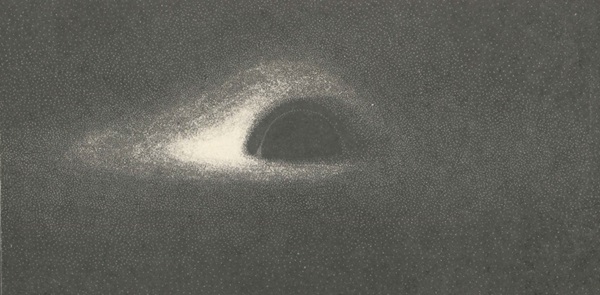
Image: A rendering of a black hole drawn by Jean-Pierre Luminet in 1978