
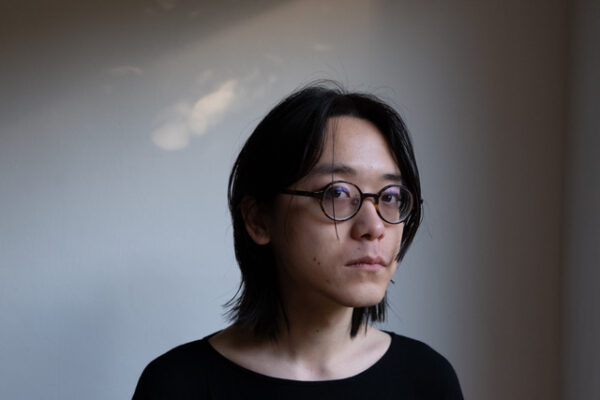
In Perennial Counterpart, Yongyu Chen’s debut poetry collection, reading, like friendship, is “a way of life.” With an elliptical, contemplative voice and a scholar’s critical disposition, Chen attends to all things that both connect and separate: tunnels, membranes, clothing, screens, pages in a book, a blank space between words. Poems act as intimate explorations of the ever-shifting nature of relation itself, with “being-together-alone” emerging as a sublime mode of connection.
Here, we discuss difficulty & reversibility, influences & non-influences, and “the lettery feeling of friendship.”
—Lucia Kan-Sperling
Lucia Kan-Sperling: The poems in Perennial Counterpart meander through time—dated between 2021 and 2025—and space: Cambridge, Paris, Barcelona, London, a bedroom, a car, many walks. Could you describe the process of writing this book? How did it begin? How did it end?
Yongyu Chen: There was no process in writing this book. For a long time I was just working on one poem, over many weeks, & it absorbed all the sentences I made, & felt like a totality—which would be replaced rather than added-to by the next poem. Only recently does it feel like I’m able to write something not total for me, & I enjoy that feeling.
Most of the work in this book is from 2021–2023. I missed my friends since it was the pandemic, & wrote letters to them. I liked the lettery feeling of friendship. Around that time, I read Michel Foucault’s “Friendship as a Way of Life” & felt very attached to it. I was reading many writers for the first time who felt immediately important to me.
The last poems I wrote in the book came from a very different place. During the editing process, I was reading a lot of Alice Notley & thinking of something she said about looking back on her poem “Dear Dark Continent”: “How honestly did I believe those last lines when I wrote them?” A lot of the work no longer felt true to me & the editing process tried to deal with that.
I did travel in the meantime & remembered other cities & imagined myself as other people in other places; the one time London is mentioned—that was not based on my own experience. All the poems were written while I lived in Cambridge.
Lucia Kan-Sperling: A primary concern of this work is “friendship as a way of life.” This mode of relation has potential both for magical connection and intense pain or misrecognition, a duality you explore in phrases such as “Being-together-alone,” or your mention of the French word partager—“in one word, both divide and share.” Could you say more about how these poems investigate the different possibilities and impossibilities of friendship?
Yongyu Chen: I tend to resist an idea, a feeling, or anything once I get used to it . . . I began answering these questions in Durham, where I was visiting my friend to whom I called this my principle of reversal, or the canonical magic of reversibility, or just a belief in difficulty.
The earlier poems in this book are grounded in the lightness & frothy relational inventiveness in that Foucault interview, which I read for a class by Afsaneh Najmabadi, & grounded too in the comparable lightness of Roland Barthes’s desire for a rhythmic alternation of being-together & being-alone in How to Live Together, which I read for a class by Namwali Serpell.
Then I felt very differently about everything; other poems were written while I was very attached to an essay that Hannah Black wrote for Barbara Hammer’s photographs, partly about how “[t]he stranger is just as sympathetic a political category as the friend, and the capacity to stay strange can feel as life-affirming as love.” Constant though is my wanting to write (& my regretting writing, though very rarely) in a way that might intensify or complicate my relations, & experiences.
Lucia Kan-Sperling: Other artists appear throughout this book: poets (most notably Ingeborg Bachmann), but also novelists, philosophers, filmmakers, musicians, and your personal correspondences. Could you say more about how reading (and watching, looking, listening) and writing are porous for you? How do poems function as thought?
Ingeborg Bachmann’s short stories are special for me; it’s also meaningful to me that some of the friends with whom I’ve shared “The Thirtieth Year” in particular have found it to possess a talismanic bearing on them as well. I’m happy she is a persistent presence in this book. I also love her Frankfurt Lectures on poetics & other critical texts.
I thought recently that—besides Bachmann being there—the endnotes & the grouping of names & references there feel arbitrary, & don’t really form a picture of me or what I want. I was thinking of references I didn’t acknowledge, some because they come underneath a threshold of intelligibility as reference. I was thinking for instance of my poem “Truant,” whose personal meaning for me is tied to that book of Barbara Hammer photographs mentioned above, Truant, & more specifically the essay Hannah Black wrote for it. But the poem itself is talking about the poet H.D. The connection of the poem to Hammer & Black is more interesting to me; but it’s also the one not noted. The connection of Hammer & Black to H.D. through the poem is more complicated & even fainter if it exists at all, & so maybe even more important & unnoted.
“Porous” is your word, but I think it may not be mine. I feel lots of internal resistance to it… (whereas I’m very drawn to something like “variegated”?) I do think reading, writing, listening, thinking, etc. are necessarily porous. I really love listening to music! In films, I like it most when the people inside are listening to a song.
Lucia Kan-Sperling: In addition to being a poet, you are also a scholar of film and photography. How does your engagement with visual media influence your writing?
By the time I was thinking of graduate school, I wanted to write poetry, but felt compelled—insofar as I thought graduate school was the right path for me—to study something other than poetry, which was film.
The research I’ve done as a PhD student is about photography, which for me is more loveable than film. My writing is not especially influenced by an engagement with visual media. Though I think—without having looked into this further—I like the kinds of poems that surround photography: the poems photographers write, or are written for photographers. I think of the poems Gōzō Yoshimasu wrote for Nobuyoshi Araki’s Sentimental Journey and for Yutaka Takanashi’s Toshi-e.
When I entered graduate school I was interested in being a scholar, but I’ve worked out that I’m not a scholar & will never be a scholar of any kind, even a good kind. I’ll just never be like that!
Lucia Kan-Sperling: You speak French, Spanish, and German, and instances of citation and translation from other languages are present throughout Perennial Counterpart. What role do language learning and translation play in your writing, your life? Have you ever written poetry in other languages?
I started learning French in high school, in Tennessee, & it’s the non-English language I feel most comfortable in, besides Mandarin, my mother tongue. Spanish & German I both learned to read particular poets, initially Lorca & Celan. German, in another sense, I started to learn for no reason at all. There is some poorly written German in Perennial Counterpart & I hope that’s ok! I am interested in writing poetry in other languages. This is less about the kind of poetry that might emerge from the use of a language in which I have less training (as with Samuel Beckett in French) than it is about my interest—maybe?—just in doing something badly, in a badness (a squiggliness) without criteria, from beginning to end.