
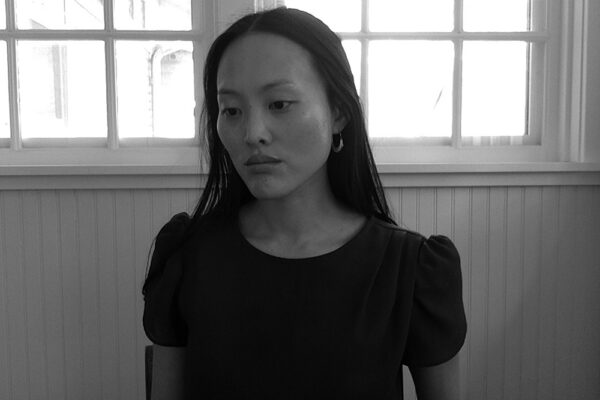
Valerie Hsiung’s The pedestrian is a hybrid novel, a contaminated lullaby, and a distorted detective story that encircles a mother, a child, a house, a body. Through its maze of uncanny repetitions and ritual self-estrangements, the book outlines the shadows of a haunted childhood, among which the reader becomes a perpetual wanderer.
In this conversation, we discuss environmental criminology, language as incantation, and throwing a blanket over a ghost.
—Lucia Kan-Sperling
Lucia Kan-Sperling: Could you tell me about how this book came to be?
Valerie Hsiung: Well, it was like a ghost entered the room, a ghost that I had known as long as I have known anything—the ghost of childhood, the ghost of exile—and this ghost seemed to make consciousness present to me—as though the ghost were saying, do you hear that? do you hear that voice? I did. It, that voice, had traveled so far to be there, it had traveled what felt like many earths away to tell me something that was also always internal already—this intimacy across distance, which is the only intimacy that has ever been true in what I know of a family, of a life—so even though it was a voice being chased and a voice chasing, the book was already whole from the beginning. I only had to obey. And then, after those first few pages were written, I realized I was beside myself—literally, beside myself—my hand on my own shoulder, watching myself in my own presence.
Lucia Kan-Sperling: The protagonist of The pedestrian has, at some point in childhood, been “split in two” by an event that cleaved her temporal experience into a “first life” and a “second life.” Do you see this book as putting forth a poetics of trauma, of a “before” and “after”?
Valerie Hsiung: I see this as the first book I wrote where grief was allowed to become its own temporality, from the first word to the last. I think that in some of my previous works, I began exploring this notion in nascent ways but this idea was not totally embraced until The pedestrian and then became a guiding force of its own. Time is its own secret agent in this book as much as it is a philosophy being imbued into the voice, giving this voice its sound and shape. In that sense, I don’t have quarrel with that idea, that this book may be putting forth a poetics of trauma, because the language is an arrival to think through trauma, in the sense that trauma moves through the personal and is given agency to make new worlds.
Lucia Kan-Sperling: There is much concealment at work in this book, with scenes turning on cryptic descriptions such as “the nameless tree tilting against the deck like it was the negative of another nameless tree” (84). Could you talk more about your use of language as a method of revealing and obscuring at the same time?
Valerie Hsiung: I believe that poetry is a special place where language is freed from the illusion of singular human design. The work of The pedestrian was not merely to name the ghosts or to even give them a voice but to make a place where they could name themselves, where their voices could overtake the language, and, when they had to, use me to their own ends. But how do you manifest the presence of a ghost? By throwing a blanket over them. This is the secret knowledge of The pedestrian. It recognizes the paradox that sometimes the only way to manifest the presence of a ghost is to cast something over the ghost. Then, and sometimes only then, does its form come forward. This is the mechanism of hiding something to reveal its true form. To reveal the true form of a ghost, of the dead, sometimes you must work with this double negativity.
Then there is the politics of language that make it so that certain things cannot be faced fully frontally, that certain things cannot survive a direct attack. It is tactical mutiny. There is a whole history of revenge predicated on the notion that certain types of utter abjection require resorting to more disguised tactics. C. L. R. James talks about this in The Black Jacobins, and I wrote about this in my essay on yodeling—The pedestrian is aware that their revenge will not be complete by being fully direct or fully visible. Their revenge will only make itself known rather in time, through a slow administration of poison, in a method which collaborates with time, to accumulate through time and to unfold in time, until that fateful threshold is crossed, until the poison has finally reached its lethal dose. This is not hiding for the sake of play, this is hiding because there is no way otherwise for us to enact our revenge. What a luxury for some to be able to come out in plain sight and execute their deed.
Some have not always had strength on their side—so instead we learn how to use torque to redirect the force of violence. Neither obvious nor direct, the power of torque lies, like the art of poison, in its cunning and its misdirection. The pedestrian is not a book of ballistic or brute strength, but a language that uses torque and a secret knowledge of gravity to enact its escape.
Lucia Kan-Sperling: The events of The pedestrian revolve around the figure of the “house,” both as an inhabitable space and a pattern of bodily relation: “she began to see when others looked at her. She didn’t know this was each time the house trying to look at itself” (8). How did you arrive at this image?
And for you, is it always the same house?
Valerie Hsiung: The process of writing this book was truly mystical, confounding really. From its first breath, it was always a treacherous entanglement of environment and body. I feel very much that the first encounter with that ghost was a kind of crime recaptured. And within the belly or basement of the book is probably an instinctive understanding of theories of environmental criminology—the idea of there being conditions that allow a crime to occur—the time of day, the absence or presence of a nearby guardian, the way a street is situated. This ghost read my longing—to remove the crime out from a single body, even a single consciousness, one lifespan, because of course that is a lie . . . and beyond that, to show how the interconnectedness isn’t even a perfect circle, but is actually something kind of horrifying, prismatic yet horrifying.
And no, it is never the same house. I think with almost all of my work, the most stable entities elsewhere must be untethered and recast as only ever unstable. And I believe that is what poetry is for. To remind us that we do not belong to ourselves. Our writing is not our own. Our body is not our own. Our selves are not our own. The lie of bodily autonomy is really such a fantasy of liberalism, just as ownership and private property are. The house in this book is open to strangers, people passing through, coming and going, never staying, just as the pedestrian is someone who is always passing through the lives of others—there are many houses in this stretch of earthly time that we wander into by mistake . . .
Lucia Kan-Sperling: The rhythm of your prose in The pedestrian is so hypnotic, it almost feels like an incantation. As a writer, what is your relationship to ritual, or to the occult?
Valerie Hsiung: I believe that language sterilized or sanitized of its mystery becomes a tool for propaganda and fascist regimes. There are too many “strong poems” which I believe were written with the intention of being anti-fascist agents but in fact wind up so easily as little monuments themselves for those same regimes of thought. If we understand the work of experimental poetry to be to fight against the wieldable story, the wieldable poem, then it becomes very clear what the incantatory possibilities of language can do for us.
Incantation is a deviation from ordinary capitalist life. Start chanting on the side of the street and see what accusations emerge. That is the threat of incantation. But our earth-bound traditions are inextricably tied to incantation—rites and rituals, of birth, loss, transformation, and death—our besoiled parts have always used incantation as accompaniment through the painful portals of life because it connects us to the more-than-human, the not yet born, the deepest chasm.
Incantation is also that truth of poetry that spits on the ground in front of virtuosity. There is no great poetry without virtuosity—which comes only from reading and absorbing and reading and finding new language to respond to what we have read and encountered not just in books, but in people, in landscapes, in soundscapes, in dialects, in idioms, in legalese, in mistranslations, but there is no poetry at all without duende, what Nathaniel Mackey calls “deep trouble.” I am not greatly moved by writing that isn’t primarily interested in that place where the soul is forced to make a home amidst the groundlessness of everyday death—those poems can veer into becoming soap operas, which of course we go to in order to have a particular kind of experience, but soap operas can make a mockery of duende. Their tears are not real. They are like the tears of someone hired to weep at a funeral. Of course, we hired these professional wailers because our societies so desperately lack the proper mourning infrastructures for real grieving so I do not blame them for that, which is to say I find myself more alienated by language that does not reckon with the truth of the way we are in ways both violent and sublime alienated from our language, and yet I do blame them when alienation becomes the end goal, like it was the only remaining truth. Of course, we should be working with alienation, and we should always be conscious that the hired tears are always threatening us. But ritual returns us to the real collective tears.
I seek a place where language is allowed to act as a continuously unfolding ceremony—rather than merely giving form to experience, which feels a bit sheltered or disengaged with the fact that words are receiving things as much as they are expressing things—and so the ritual of poetry is this recognition, that all voices in the room will be picked up by the feedback and that will generate its own experience. I believe that poetry should overtake the writer and become its own demanding existence. Back to the idea of temporality—that is what ritual calls attention to, after all—that we are being gathered by time, because of time, in time, and, even in our lateness, on time. Poetry is the deepest reality to me because it means letting language reveal its own reality to us. This is what true incantation does as well—it opens a portal that connects the unconscious to the future—I’ve always found it strange when people automatically associate the unconscious with a mining of the past when it seems obvious to me that it is our ride to the future. And I guess I feel that this is the possibility of ritual. That it gives us a chance to bridge the past to the future. Perhaps incantation is the recognition that you have to create the thing that destroys you, to make way for the future. Because without it, they will in all likelihood kill us and make us sing their stupid songs about it. I would rather make my own songs to mark the moment. Ritual recognizes that these songs we make are little machines that will take us from the past to the future and back again.