
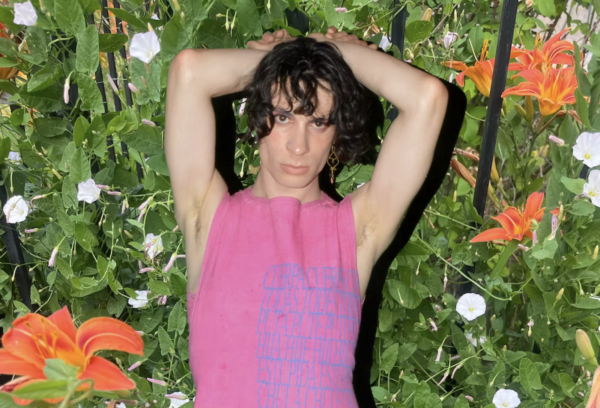
In E, Noa Micaela Fields takes on Louis Zukofsky’s monumental long poem “A,” placing it in the register of the trans-autobiographical. Working in, and against, the tradition of homophonic translation, Fields transposes Zukosky as heard through her hearing aids, amidst the soundscape of trans nightlife—like a hijacked, hormone-induced game of “Telephone.”
Here, we discuss mishearing as radical methodology, and the “unruliness of straying towards other, unheard sonic alternatives.”
—Dante Silva
Dante Silva: How did you come to Louis Zukofsky’s “A”? How did “A” become E?
Noa Micaela Fields: I found a beat up copy of Zukofsky’s objectivist long poem “A” in a local bookstore during the first COVID summer. I started playing with the book as material to alter, starting with the big anarchist “A” I drew on the cover, and then writing associative erasures and later mishearings in the margins. This was just before when I started E, or estrogen. Not to imply a causal relationship. After all, I’m the one who’s making “Louise” Zukofsky out to be a little trans in my book. It’s definitely not a stretch at all to say Zukofsky’s embodied approach to poetry—specifically, rituals of homophonic translation in pursuit of other languages’ incantatory mouthfeel—made me and my poetry at least a little more trans, as I experimented in ways of transcribing myself becoming something else as it emerged on the page, and in the ear by way of mishearing’s glitchy evolutions. I kept coming back to Zukofsky’s “A” as a companion text in my poetic journey of departing and never quite arriving.
Dante Silva: Louis Zukofsky called “A” a “poem of a life.” Would you describe your poems as poems of a life?
Noa Micaela Fields: Zukofsky wrote and published “A” serially across five decades, and that gives his “poem of a life” the cumulative weight of time and labor, against a backdrop of personal and historical changes. The lifespan of the poems in my debut book are only the past five years, which by comparison is only a beginning, a new lease on my life in transition in the context of the pandemic’s global nightmare.
But aside from the length of gestation, I do consider E’s poems of a life—mine of course, but also they pursue a life of their own: these poems are alive and responsive in relation to life, embracing change as sacred. This book is my palimpsest tracking that emergence over time. I too am interested in the aliveness of a poem and its relation to life, whether or not E continues as a long form poem beyond this book.
Dante Silva: I read the first poem in the collection, “Homophonic, Trans Later,” as an argument for the more radical capacities of homophonic (trans)lation. How would you describe your intervention in the form?
Noa Micaela Fields: Homophonic translation tries to relay a somatic or auditory hallucination of another language, as if it’s rolling around on your tongue even if you don’t know the language at all. I was interested in that gesture of trying to break into language from the outside, a sacred inversion of something missed. It makes me think of the glitch of my hearing aids in loud places, or a whispered message in a game of telephone that falters in transmission and instead leads somewhere else, an unpredictable horizon. So I transferred the call from translation to access to develop my own crip aesthetic. In my version of homophonic translation, I experimented with echoes, fragmentation, and counterpoint to introduce a slippery waywardness even within English. I tried to relay a sense of freedom in mishearing’s queer potentiality, in the unruliness of straying towards other, unheard sonic alternatives.
Dante Silva: When I heard you read from the book, at the Segue reading series, I was struck by a sense of theatricality, intonation, and improvisation, all of which is abundantly obvious in the poems themselves. How did you develop those senses?
Noa Micaela Fields: That’s generous of you to ascribe those qualities to my performance. I relish the iterative nature of live performance as an opportunity to remix poems, which exists so differently on the page for me.
Intonation: I think about my years of going to speech therapy growing up, which gave me a sense of hyperawareness of speech, articulation, especially when there’s a communication breakdown. In music, intonation refers to pitch accuracy. I always struggled with staying in tune in the higher registers on my violin and I find it much easier to play piano, an instrument where simply pressing down the key releases the desired pitch, no guessing games required. I do think of poetry as a musical instrument too, and I try to pay close attention to the quality of vowels or sonic clusters as a melodic constellation. Maybe that’s another affinity that drew me to Zukofsky’s poetry, which he described as “lower limit speech, upper limit music.”
I’ll say one more thing about improvisation: I trust in process based discovery, experimentation. In working with Zukofsky as a point of departure, there’s a lot that emerged gradually over time from found text, without necessarily knowing what I meant by something initially, and there was a lot of stumbling, fumbling in the dark, until my intuition led me somewhere eventually, without a sense of a fixed destination. It’s all a draft.
Dante Silva: There’s a long lineage of poets and artists that you’re part of, as seen in the epigraphs here (which include the likes of JJJJJerome Ellis, Juliana Huxtable, and others). E also exists as other collaborations, and encourages creative interpretations of itself. Is there a politics to that practice of play, polyvocality?
Noa Micaela Fields: Trans life, I think, entails a polyvocality of being singular plural. Not in the grammatical sense of “they/them” pronouns—I mean the material stakes of our entanglement, embodiment through co-conspiracy and collaboration. There is no one way to be trans and it’s essential to honor the vastly varied vocabularies and life practices of gender across generations and geographies. What we learn from and give to each other. That to me is what “t4t” as a commitment means. Epigraphs were one way I tried to honor some people whose art influenced mine and made space for me to grow into myself. Some of the other writers whose words I cite in the book include Andrea Abi-Karam, Jada Renée Allen, Jos Charles, kari edwards, T Fleischmann, Duriel E. Harris, José Muñoz, Erica Hunt, and TC Tolbert. Thank you.