
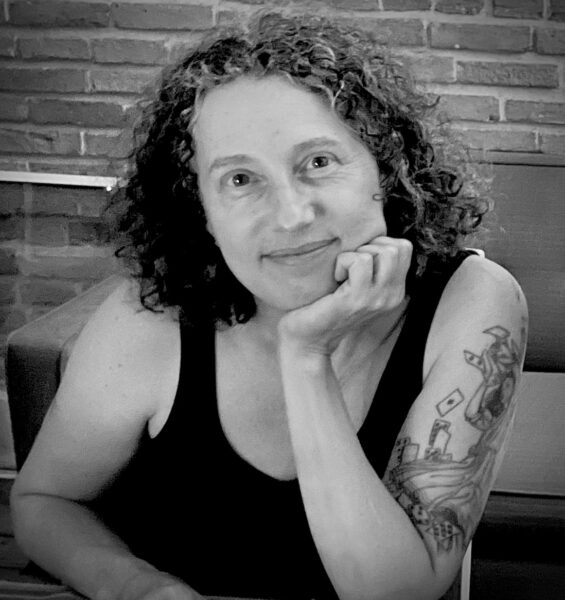
Miranda Mellis’ Crocosmia, out now from Nightboat, starts at the “end,” a concept she troubles (the “end,” of course, continues to happen). The novel recounts the protagonist’s childhood during the “great turning,” a series of radical social and ecological changes brought about, for the most part, by her mother’s “psychokinetic animation” art. It imagines that change through the institutions of communal life—libraries, language, etc.—and the relationships, real, completely reimagined, between such institutions and individuals.
“The real would emerge from the fictive, as it always did,” Mellis writes in our conversation below. “The fictive would emerge from the real, as it always did.”
—Dante Silva
Dante Silva: The novel starts at the end, or “the end of the end, followed by many beginnings.” It’s eschatological in that sense—we have the ruined world (fall), the crocosmia, the communities that rebuild (redemption), the return of life and liveliness to the world (resurrection).
How does Crocosmia work with and against the trope of “apocalypse”? Is there a theology/theologies that you’re working through?
Miranda Mellis: May works of speculative fiction, science fiction, be seen as experimental forms of theology, in their future tripping? I have heard the future described as the present, in superposition. As non-empirical, perceptual, distributed-social cognitive mapping, what is theology but intricate theorizations of deities and divinities as intelligences outside of spacetime?
The etymon, the stem and root–as we say, for language is botanical–is kalyptein, which means to cover, conceal, or save. Calypso means ‘she who conceals.’ The prefix apo concerns distance, or going away from, so the etymology of the word apocalypse is uncovering or revealing. Of apocalypse Fredric Jameson said, “It’s easier to imagine the end of the world than the end of capitalism.” Jameson uses the word ‘easier’ pointing to the difficulty. For those culture workers, for those whose terrain is seeding possibility through the imaginative, this despairing refrain could be interpreted as a call to action: How to make it “easier” to imagine the end of capitalism? Here the word facilitate comes to mind, at the center of which is facile, which means ease or easy; to facilitate is to make easier. What can the imagination facilitate? In the imaginary of Crocosmia, capitalism comes to an end, so that the world can stop ending.
Crocosmia is in conversation with thea/logy–feminist theology, which includes apocalypse, but instead of “the world” coming to an end, it is those forms of worlding that precipitate omnicide that end, that is, patriarchy and its concomitants: capitalist exploitation; the anthropocentric ideology of Christian dominion with its central emblem, the crucifix, (an instrument of torture, and at the same time, a crossroads/place where opposites meet); white supremacist metaphysics that underly colonialist expropriation; industrial ecocide; classist pathologies of carceral othering; genderist ideologies of social control–these are what undergo an apocalypse.
Death and birth, endings and beginnings, belong to one another, turn into each other, dream about each other. One historical time dreams the next. How do we awaken from the bad dream of patriarchal paranoia and earth devouring consumerism?
Dante Silva: Jane, the protagonist’s mother, is an artist whose central theme is decay—a theme that you distort. How does decay become productive?
Miranda Mellis: There’s aesthetics of decay, genres of decay-love, like Goth, dancing skeletons, and figures of decay, like the old witch in the forest, and tropes of decay in fables of regeneration, where loving, wise actions allow that which has been trapped in the spell of an inapt form; dying; or even dead to go through metamorphosis, to get unstuck, to awaken, to change, and be renewed. In such fables there is counsel and teaching about the wisdom of honoring impermanence and regeneration and the dangers of disrespecting or exiling decay. In ecosystems, the colors of decay, brown, white, and black signify bacterial action and metamorphosis. The problem is we have this word garbage, but nothing gets “thrown away.” As Vanessa Machado de Oliveira puts it in a discussion of “metabolic literacies” in a chapter called “There Is No Away” in Hospicing Modernity, we must not only metabolize and process material waste, but consider also how to “compost” ideational and epistemological waste for transformation: “Generative disenchantment and disillusionment with modernity’s modes of relationship are indispensable aspects of hospicing modernity, processing its teachings, and composting its waste. This creates new, fertile soil for other possibilities of existence to emerge.” In Crocosmia this is central, that even those who are causing harm and damage have the potential to become useful waste. Machado de Oliveira invokes the possibility of treating what is called waste as deserving of respect:
Some cultures . . . pray for the food to give them health and strength to be in service of others. But, what would a prayer look like for what we return to the earth? Who or what would you be grateful for? What could be a good prayer for your shit and the land that will receive it (think beyond your own digestion)? . . . The next time you need to go to the toilet, pause for a while as things are brewing, and contemplate that part of you that will be released in a metabolic cycle that does not stop with the flush.
Jane Bennett writes in Vibrant Matter of understanding landfills as full of agency and vitality. In Crocosmia there is a correlation between those who hoard power and refuse to step down—for example, they don’t have a chance of winning an election, so they manipulate the electoral system—and the refusal of decay. The willingness to share power, to surrender, is a mark of respect for the centrality of decay, including ego death, which is liberation, and the humbling decay of one’s own aspirations as you go through your life cycles.
We live in a world where the consumption of 80 of the richest people is equal to that of 3 billion people. This is beyond pathological. The fact of it calls for demonology (as distinct from demonization). Lama Tsultrim Allione has written a book about “feeding the demons.” When you feed the demons just right, they disappear. But what do you do with demons whose appetite consumes the whole geosphere?
A person’s needs may be met for food, water, shelter, garments, friends, safety, music, poetry, learning, healthcare, connection, meaning, and joyful purpose. When basic needs are met (including the need for viscerally felt kinship with ancestors, animals, trees, and water) and love is present, we’re good. Love, forgiveness, spirit is most luxurious. But capitalism incentivizes this pathetic and irrational hoarding, capital accumulation, which can be understood in many ways. Political economy and history can help us understand. Another way it can be understood is as a denial of impermanence. In this spirit, Crocosmia proposes that “Deterioration is also one of the muses, the unmentionable ones. Instead of inspiring, the muses of decay expire. What’s the nature of that which refuses to decay, fall apart, to go down, be done with? Compare a microwave on its side by a swamp, or a suitcase in a river, with the bones of a flying squirrel. The tyrannical cells of the sore loser who refuses to concede with the humor of the good sport who knows the game is change. Compare the infamous ‘black mayonnaise’ of toxic sludge that killed so much marine life, to the ink of squid.”
Dante Silva: That work is a speculative fiction of sorts. I’m curious about fiction, its more radical potentials, especially since you come to the work as a poet. What work does the form allow for, at its fringes?
Miranda Mellis: Thought takes form, and some say that by being given weight, it becomes probabilistic. Prophecy in that sense is a kind of speculative fiction. Prophecy is an art–shaping time within the temporal domain we seem to live in: the present. Part of that present includes our perception of and relation to the future, which everyone has access to, and can explore, think about, and modify. What do we see? For us, there is no future outside of our perception of it; we only ever live in this one ever-changing moment. What if every person, just by virtue of the perception of the future, has a hand in shaping it? What if we are all engaging in speculative fiction, all the time?
Storytelling is a human passion and a need as important to us as food and shelter, and it has enormous effects on our ideas about what might or might not be possible. It is also happening in the mind all the time, in every moment we are living into the stories we tell and hear. We are internally rewired by everything we take in, including interactions with others, hormonal emanations of strangers, our friends and neighbors, TikTok, Instagram, film, ornamentation, music, and the seductions of advertising—and many shows and movies produced under the aegis of the entertainment industrial complex are long, elaborate ads, a cultivation of consumerist subjects through identifications imbricated with franchises. Initiations have traditionally happened through direct transmission, in embodied relationships that open the way to expanding familial relationships, to finding and connecting with familiars—plants, places, animals—and learning enciphered chant, poetry, and symbology. The aesthetic just saturates everything, but what are its purposes? Walter Benjamin famously said that while fascism aestheticizes politics, communism must politicize aesthetics.
To work on this novel has been to take up political desire and potential as a formal question. Technically it has required the capacities of poetry, and, in addition, it has required me to struggle with duration. The organization of time over a long, multifaceted, but somehow unified story is just a whole different architectural proposition.
Bakhtin is a touchstone for me, his concept of polyphony, the idea of a novel as dialogic, as holding a plurality of “unmerged voices and consciousnesses,” sometimes incommensurate points of view and voices, including that of an author, combines aesthetic pleasure with a principle of inclusivity. The novel becomes a kind of pluralistic assembly, the formal, artistic enactment of an ethos.
Here in 2025, during what feels like the end of the world, can we change the story? Every day, on the ground, people are doing so. The question of the attention economy is alive. All over the country, all over the world, people organize, people practice mutual aid, remediation, reparation, cultivation of democratic social care. As what little we had in the way of social safety nets is shredded this is increasingly salient. Any city you go to, you’ll find bookstores, workplaces, community centers, clinics, classrooms, cooperatives where the ethos is, we keep us safe. One hears anecdotes about a sea change which reflects the fragility and unviability of what Starhawk calls “power over” when it comes to decision making. Whereas people had been socialized to aspire to leadership as domination and control, as part of a careerist ascent, a kind of false and lowering pragmatism, there is widespread ambivalence and doubt. People don’t want those roles. As abuses by so-called “leaders” are laid bare time and again, a question arises as to whether reified hierarchy inherently produces abuse. Those who provide the guidance we truly need don’t practice domination or raise themselves above others. Other, non-harming, non-dominating ways of being and doing things, a higher order pragmatism, has always been with us. We know this.
Despite the reactionary counterrevolution underway to undermine the work people have done to plant seeds for egalitarian pluralism, equity and inclusivity, it won’t work. People are modestly, incrementally, or sometimes radically from the ground up conceptualizing other ways of doing things in even very normative, conventional institutions, by means of co-leadership, shared decision making, modes of collective and cooperative organization that preclude power hoarding and ask everyone to attend and be present to the deeper questions and projects that matter to them and their communities. While this cooperativism and disillusionment with hierarchy is gaining momentum, totalitarianism, dictatorship, authoritarianism, and police statism seem in ascendance, forcing street battles and all the usual terrors and tortures we know so well from so many places and times of colonialist empire, dragging us down. We are at a crux / crossroads, and it matters what and how we imagine the future.
Dante Silva: The work decenters, and then challenges, the “human.” It’s also so humanist, humane. How do you hold those philosophies together?
Miranda Mellis: Humanism, which has been concerned with human welfare, has anthropocentrism baked in, due to its imbrication with aspects of Judeo-Christian cosmology and the fantasy of a “view from nowhere” of scientism which have mistakenly described the planet as something it has been incarnated to dominate, own, measure, quantify, exploit, and use. To emerge as a being of nature-culture, gifted breath, a body, and a mind, and to turn around and look at those conditions and enclose and hoard what has been given, what has been offered, is at the heart of the narcissistic and ignorant pathologies of ecocide and war. All wars are about land. The parables Jesus taught indicated a sacred plane asymptotically proximal: a heavenly realm “near to hand” of the sacred itself. It’s a perceptual shift, of the kind that koan and other kinds of cognitive medicine can bring about, a recognition of the life of what is: just this. Platonic forms ripple around, indicating shaping energies. But Platonic form has been misunderstood as something higher or more “real” than what is perceptible, leading to misapprehensions about the realm we find ourselves in, which is symbiotic, participatory, contiguous with mind, and in which our observations, descriptions, and presences are shaping. Humanism and the very notion of the human has always been bound up with colonialist and genderist metaphysics and racial capitalism and has been undergoing a necessary transformation in its self-understanding under pressure of anti-colonial, anti-capitalist, anti-racist, feminist, and decolonizing thought. Humus is earth. A return to earth is a return to the origins of the word “human” which emanates from the proto-Indo-European (dh)ghomon: earthling, or earthly being. We could call ourselves humus beings, or humble beings, or humor beings. I learned to ask from one of my teachers Thalia Field: are we sure species exist?
Dante Silva: Jane’s library, consisting of books rescued from dumpsters, is a social site. Knowledge is a collective, collaborative practice, one that consists of conversations about “psychogeography, cosmic perspectivalism, Indigenous bioethics, comparative prophesy.”
I love the taxonomies of knowledge that you present—it matters not just what we know, but how we come to know it. What made you include these particulars?
Miranda Mellis: Because I have been teaching for 20 years, and for the past 13 of those at Evergreen where we team-teach interdisciplinarity, my mind tapestries curriculum. It’s an instrument I know how to play. It combines planning and improvisation, logic and intuition. I had fun imagining curriculum in the novel, playing with a kind pedagogical infinitude of possible arrangements, assemblages, juxtapositions, and reconfigurations, bringing things together that have been kept apart. Throwing a lot of things into the bag and shaking it. Ursula K. Le Guin’s essay “The Carrier Bag Theory of Fiction” could apply to knowledge-making: the carrier bag theory of pedagogy. I am shaped by movements for what Ivan Illich called unlearning or de-schooling, the undoing and de-creation of forms of educational praxis that are stultifying, that aim to produce compliance instead of dialogue. In the section you mention, Jane’s apartment is also a public library.
Dante Silva: I was completely captivated by this world and wanted more. What would you recommend reading after, or alongside, Crocosmia?
Miranda Mellis: Ursula K. Le Guin’s The Dispossessed: An Ambiguous Utopia and for more ambiguous topoi, Samuel R. Delany’s Trouble on Triton: An Ambiguous Heterotopia; Kim Stanley Robinson’s The Ministry for the Future; Monique Wittig’s Les Guérillères; Andrei Platonov’s Soul; Octavia E. Butler’s Parable of the Sower; M. E. O’ Brien and Eman Abdelhadi’s Everything for Everyone: An Oral History of the New York Commune, 2052-2072; Shahrnush Parsipur’s Women Without Men; Roy Scranton’s We’re Doomed. Now What?; Michael Taussig’s The Magic of the State; Eduardo Viveiros de Castro and Déborah Danowski’s The Ends of the World; Fanny Howe’s Night Philosophy; Alexis Pauline Gumbs’s Undrowned; Ibtisam Azem’s The Book of Disappearance; Norman Manea’s On Clowns: The Dictator and the Artist; Starhawk’s Truth or Dare; Cassie Thornton’s It’s Too Late. Do It Anyway! A Book About Being a Culture Worker in the Apocalypse & a Hologram Starter Kit; Eleni Stecopoulos’s Dreaming in the Fault Zone: A Poetics of Healing. Shahrnush Parsipur has a political science fiction novel called Shiva that I strongly suspect would be on this list but I have not read it yet, as it has not yet been translated into English from the Persian. There are many great anthologies of speculative eco-fiction. One of my favorite short climate fictions is “Half-Eaten Cities” by Vajra Chandrasekera.