
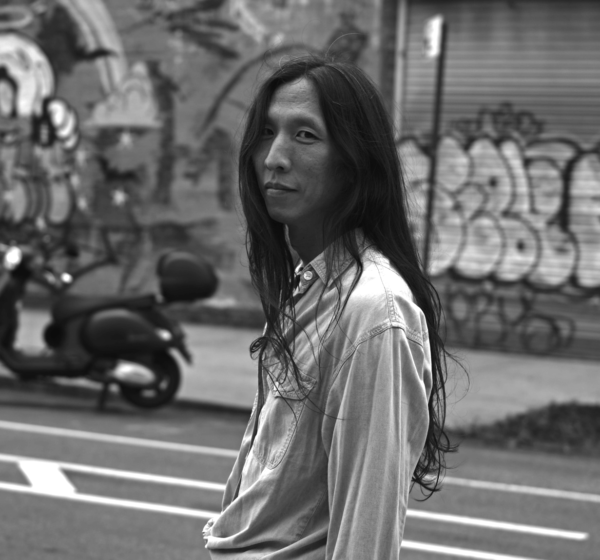
Joon Oluchi Lee’s Tricyclist, out now from Nightboat, is interested in the instability of things. It’s a novel that turns identities, desires, and relationships inside out, along with the meanings we make from them. Here, I spoke with Lee about porn magazines (he’s decidedly in favor), misrecognition, and the strange, sensual work of turning materiality into feeling.
—Dante Silva
Dante Silva: Why Tricyclist? What made that the right title?
Joon Oluchi Lee: I’m always interested in the process of becoming whoever you are going to become—I don’t believe that anyone ever completes that process in their life (if they do, they are deluded or boring). So with this book, and the character of Howie, I wanted to think about a person who is perpetually not quite making it—who is slipping between the cracks, who is always wobbling on the bicycle, always in need of training wheels. That got me thinking about a tricycle, which to me became like a spirit-object for the book: it indicates immaturity or lack of mastery, but at the same time, it is that third wheel, the extra that is the tell-tale of immaturity, that gives the rider of the tricycle a sense of stability and in fact allows him or her to get around on wheels. We have the word “bicyclist” but not “tricyclist,” because in our culture, we don’t want to monumentalize a state of flux or immaturity. So in some ways, Tricyclist the title is a continuation of the title of my previous book Neotenica but more specifically about living while wobbling, wobbling as a way of walking, living as and with a third wheel.
Dante Silva: You’ve worked across forms for years, and Tricyclist feels the most decidedly a novel out of all of your projects. What made it want to be one?
Joon Oluchi Lee: In my previous work, I was really led by the shape of a certain idea or a certain story: As I wrote, I always had a pretty strong, sharp image of what the story or concept would look like from a zoomed-out, overhead view. With Tricyclist, I didn’t have such a focused idea or story. Instead, I began by giving myself a formal exercise: to write each chapter as a diptych of conversations and gay porn. What then happened was that I became interested in Howie as a character the more I wrote about him. It was a weird kind of method-acting thing where I was compelled to write chapters so that I could simultaneously learn more about who he was but also to embody him more convincingly. I suppose that is the more traditional novelistic feeling that comes through: that the book is a biography of a person who doesn’t exist yet. My hope is that Howie lives on in the reader’s mind after the novel ends, and the reader cares enough to give him a life with her or his own imagination.
Dante Silva: Clothing receives an extraordinary amount of attention in the book (and its cover, of course). There’s something obvious to be said about self-fashioning, though I’m more curious about clothing as the language through which people read and misread each other, and the textures of misrecognition and desire that emerge from that. What led to clothing having such weight here?
Joon Oluchi Lee: Yes, my interest in clothing is less about self-fashioning and more about reading/misreading and how that blooms desires that are unexpected. But for me, clothing is important more from a writerly, technician point of view: I just love using language to describe clothes. I’m a devotee of description as a literary practice: I believe in its mystical power! (As close to “spiritual” as I’ll get!) In fiction and in poetry, describing material things—be it places, animals, plants, bodies, clothes, food, furniture—is an incredibly sensual process of discovery. In translating—transmogrifying, really—things you can touch and feel and hear into abstraction of sentences, you as a writer have to interface with said material world in new ways that makes you understand both the thing you’re describing and the feelings they produce. Most writers I truly love are masters of description, and they all have their little fetishes, as in what they like to describe—for instance, Thomas Hardy, who I adore, obsesses over throats and mouths. I love to describe clothes because I love clothes, and I’m a kid who grew up balancing reading fashion magazines and poetry—there’s a whole history to be written about the descriptive language of fashion-magazine cutlines. But you’d be surprised how many writers don’t describe clothes at all. Last year I re-read Henry James’s The Golden Bowl and was reminded that as much as he (over)describes people’s states of mind, he never goes into detail about what people are wearing. It’s always disappointing to read James for that reason; he creates all these supposedly fabulous female characters but we’re just told that they are fabulous, and have no idea how they are dressed. But that’s OK because there’s always Sylvia Plath, Mary Gaitskill, Wanda Coleman, Nella Larsen for deep delicious dives into clothes. So maybe there is something to “feminine writing” after all . . .
Dante Silva: The sex in Tricyclist ranges from raunchy to awkward, abject, tender, and sometimes almost absurdly detailed. What can writing about sex do that writing about desire more abstractly can’t?
Joon Oluchi Lee: My writerly attitude towards describing sex is the same as that of describing clothes: Materiality produces feeling. I think all desire is inherently sexual, as in, sourced in a longing to make contact with the body of another human being. I read a lot of gay porn as a teenager and young adult: In those days, video porn was very difficult to access, especially for a kid in the Midwest. But I could sneak gay porn magazines like Advocate Men. Gay porn magazines then contained not just nude photos of men with erections (very important), they also contained erotic fiction that was highly descriptive of bodies and actions. Tricyclist is my homage to and enaction of that genre of short fiction. Gay prose porn, particularly from the ’90s, was precisely about describing sex and bodies in absurd detail, but that unfurled, or at least sat alongside, emotional desire, which was complicated by gay liberatory politics and AIDS. So porn is very political to me. As a gay kid growing up in the ’90s, I understood that the way straight people have sex (reproduce) was part of non-erotic, non-pornographic normal discourse, but to talk about gay people having sex was suddenly always and immediately pornographic, forbidden, shameful. So porn for gay youth is historical-pedagogical. Finally, in this day and age when we have TV shows and films that glorify and normalize violence—be it sociopaths or psychopaths, serial killers or military campaigns—I strongly believe that depicting adult humans having consensual sex with one another should not be considered violent or shameful.
Dante Silva: I have to ask about Howie, our protagonist. Is he someone you had in mind before the project began? How did he develop as you wrote him?
Joon Oluchi Lee: After Neotenica—which I like to joke is my version of The Joy Luck Club—I was like, I don’t want to write about Mother-Child relationships any more, Asian-American or otherwise. I knew I wanted to write about a gay man, and that I wanted to tell a story without any mention of biological family—which is why you’ll note there are literally no parents or siblings that appear as characters, and I actually tried hard to not even mention anyone’s bio-family. And then I knew the gay man ought to be Asian-American because that’s how I best know gay identity (duh), so I started with a name. I was thinking (as I often do) about celebrities I had crushes on in my life and for some reason the football player Howie Long came to mind; he was a big blue-eyed beautiful blond. His name already could be Chinese-American, so I thought, “Howie Song.” Which became cutesy because, “Song” like pop song. Maybe revealing this takes the magic out of Howie. Anyway, that’s how it began, and as I mentioned earlier with regard to the title, I wanted Howie to be a kind of beautiful loser; someone who doesn’t have it together, but that makes him more magnetic. My partner is quite interested in astrology, so early on in the writing process, I made up a birthdate for Howie (I knew he ought to be a Scorpio) and had my partner do a whole chart for him. The thing that kept coming up in Howie’s chart was the idea or feeling of danger, or being in danger. Which weirdly made sense because I wanted Howie to be characterized by a certain recklessness—perhaps physical, certainly emotional. I imagined him kind of flinging himself against men, against situations, against self-assessments that were perhaps self harming or toxic. So at first, I was thinking about him as a kind of gothic heroine, I suppose, pirouetting around emotional and sexual minefields; a bit sadistic of me as a writer. Then as I dropped the chapters in the jar I found myself really caring for him—even though I was creating him I felt worried for him—like I should write with more tenderness! Hopefully I was both harsh and tender.