
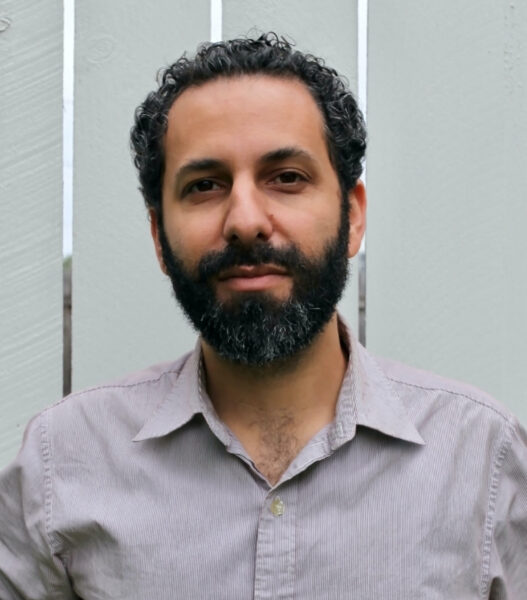
Monk Fruit, Edward Salem’s debut, is out now from Nightboat—published poignantly, as he remarks, on Refaat al-Areer’s birthday. The poems, written from a Palestinian-American perspective, move between absurdist images, memories, and the noise of the algorithm, confronting nothingness as they do—both political erasure and metaphysical negation.
In our conversation below we discuss doubt, displacement, and how his poetic practice works to “expand the boundaries of what is permissible.”
—Dante Silva
Dante Silva: “Elsewhere,” the first poem, is about place and displacement. How does the poem collapse the distance between here and elsewhere? What does it confront?
Edward Salem: Through the trapdoor of “earlier,” and by cycling through forms of escape—drinking too much, wanting to be alone, walking toward the border.
Today is Refaat al-Areer’s birthday, the same day as my book is being published. I think mentioning that is another way of answering the question.
Dante Silva: The work is somehow hilarious, it’s as if the collection has amphetamines at its center. What work does humor do here?
Edward Salem: It’s a fuck you to respectability politics. Mohammed El-Kurd writes gloriously on this subject. He says, “For one to be described as genteel, someone else needs to be viewed as savage… I am flippant because I realize that the majority of the Palestinian people do not possess the capacity or desire to coddle ethnocentric values and racist attitudes. Where, in the war zone, would I find the space to alter our vocabulary? And why should I want to? Why would I want to… comb through our colloquialisms looking to filter out the uncouth?” Elsewhere he writes about “the strategic advantage and transformative potential of humor,” and that irreverence is “a dignifying act of refusal… It expands the boundaries of what is permissible. And it is often more compelling, more gripping than memorized statistics and persuasive PowerPoint presentations”—which is what a lot of humorless poetry feels like to me.
Dante Silva: The poem “Give What You Can” collages language that we’ve all seen, and heard, about the genocide. (“H@mas. eSims. Khamas. Elbit Systems.”) How did you construct that poem? How does it work around, and against, the algorithm?
Edward Salem: It was inspired by my friend Amira Hanafi’s A Dictionary of the Revolution, which “documents the rapid amplification of public political speech following the uprising of 25 January 2011 in Egypt.” I compiled this language hoping to create an iteration of their project, but when I didn’t have capacity for that, I repurposed the language that I’d assembled into a screwy poem that I hope might memorialize and destabilize an aspect of live-streaming the genocide.
Dante Silva: I love the last line in “Tchotcke,” “my atheism has congealed into a kind of belief.” When does doubt become devotional?
Edward Salem: When is right. Not to take the question too literally, but I did get swept up in the New Atheism movement of the early aughts and the one-two punch of Christopher Hitchens’s God Is Not Great and Richard Dawkins’s The God Delusion. Filtering out the Islamophobia of other popular figures around this time, it was like UFC fighting for nerds, and a lot of fun to watch priests and rabbis getting their asses handed to them in these rousing televised public debates. With the fervor surrounding all that, the question of God’s non-existence was more or less resolved for me. But to stick with Hitchens for a second, he was good on Palestine but weirdly awful on Iraq, yet when he was challenged by Vanity Fair Editor-in-Chief Graydon Carter to subject himself to waterboarding, which Hitchens had until then denied was torture, to his credit Hitchens agreed to do it. The video is worth a watch. It plays like a Santiago Sierra artwork, it’s incredible. About 17 seconds after they begin dousing the towel over his face with water, he drops the metal object in his hand that signals he needs to bail and prompts the demonstration to end. He coughs and gasps for air as the black mask and wet towel are removed from his face, and he immediately concludes that waterboarding is torture. Which is all to say, I think it’s only through direct experience that profound transformation can take place. But that takes a willingness and openness that is likely to make you very uncomfortable at first.