
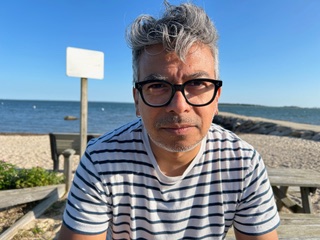
An Interview with Antonio Ochoa, Author of Small Sargasso Mountains / Pequeñas cordilleras de sargazo
Small Sargasso Mountains / Pequeñas cordilleras de sargazo is Antonio Ochoa’s first bilingual collection, a work that moves in spirals of “oscillation between hemispheres,” between poetry and prose, between Spanish and English, between experience and memory.
In this conversation, Ochoa and Dante Silva discuss translation as “transcreation,” Mexico’s colonial and multicultural history, and how the algae species sargassum invokes the interconnected currents of ecology, history, and politics.
—Lucia Kan-Sperling
Dante Silva: Is this your first translation of your own work? How did working across (and around) languages shape the writing?
Antonio Ochoa: Yes, this is the first time that I’ve worked using this method of moving back and forth between English and Spanish. I prefer the word transcreation over translation. This word was coined by Brazilian poet Haroldo de Campos to talk about the practice of translation as a creative and critical act. One of the most interesting discoveries I made while working on this manuscript using this method was that it puts the notion of an original under question. The movement between both languages allows me a deeper and more detailed exploration of experience than a single language would or has done in the past. Both languages complement, transform, and open new spaces in the poems from phonetics to grammar to metaphors and images.
Dante Silva: Sargassum, for those unfamiliar, is a species of algae found on the ocean’s surface. How do you work with its modes of drift, distance, entanglement?
Antonio Ochoa: My sister lives in Playa del Carmen. We were in Tulum some years back, it was a beautifully clear cloudless day, and I saw the sargasso on the beach below the ruins drying on the sand. It was also stretching out on the water forming an amazing curve into the distance. I imagined that curve of sargasso connecting the Caribbean with the coast of East Africa. This inevitably led me to the Middle Passage and that incredibly powerful image of Édouard Glissant’s, when he talks about the Caribbean archipelago all being interconnected by the bodies of dead slaves. One of the least known aspects of Mexican history is the role Africans have played in it. And for me this is not only an intellectual exercise. My dad was from the Gulf state of Veracruz where, before the slave trade was banned, most of the slaves disembarked in different ports along its shores. Drifting and nomads are essential images-concepts for me. They evoke the balance between the will and agency of the individual and the greater currents over which we have no power be they biological, historical, political, ecological. This balance is also an awareness, an openness, since it is in this drift where we encounter others.
Dante Silva: There’s an incredibly robust citational practice here. Édouard Glissant, Haroldo de Campos, Fred Moten, and others are in conversation across mediums, cultures, centuries. Is there a politics to the work’s polyvocality?
Antonio Ochoa: This openness allows and welcomes different things to approach one’s orbit: poems, fiction, philosophy, from history and sociology to visual arts, from music, TV, and movies to current affairs. Chance plays an essential role in this. To paraphrase Deleuze and Guattari at the beginning of A Thousand Plateaus, I use everything that comes within range, from what is closest to the farthest. Then, my imagination makes all the different elements coalesce in a poem.
Dante Silva: There are moments when the work enters a more intimate register, referencing different personal and familial memories. How do you think about those in relation to the other images, histories, and voices that are present?
Antonio Ochoa: Each of us is a plane of encounters from our family’s story to our experience of the world, the histories of our community, our country, the continent, the “West,” the world. I just finished reading Paul Gillingham’s history of Mexico. There he makes an observation that I haven’t heard before: Mexico is the first example of what we understand today as a multicultural society. It was a crossroads of the world in the sixteenth and seventeenth centuries. Peoples from the four corners of the world became inhabitants of the Kingdom of New Spain, what is today Mexico. Its population was comprised of the indigenous inhabitants; Spanish colonizers, some of whom were already not only Spanish; Asian slaves that arrived at the port of Acapulco in the Pacific; and African slaves that entered through the ports of Veracruz and Campeche in the Atlantic. All these peoples, languages, and cultures flowed together, some more evident while others imperceptibly, to form the society that is present day Mexico. It is also relevant that both of my parents were archaeologists. Mexico City itself is a kind of an architectural palimpsest. So, in the poem where I mention overhearing them discussing a stela, I mean this literally. Of course, this is how I remember it. My memory does not have a very strong chronological logic. Paul Géraldy, a French poet, wrote “memory is a poet, not a historian” and I wholeheartedly agree. Moving through all these different registers is, to me, a more faithful depiction of how the world functions than it would be an intellectually isolated line of inquiry. Of course, these are useful, but it’s not how I experience the world.
Dante Silva: The collection starts with Frankétienne’s Ready to Burst: “Spiralism aligns perfectly—in breadth and depth—with an atmosphere of explosive vertigo; it follows the movement that is at the very heart of all living things. It is a shattering of space. An exploding of time.” Could you speak to his influence on the collection?
Antonio Ochoa: Talk about encounters! I first heard about Frankétienne when I was living in Scotland in the early 2000s. In grad school I met my friend Rachel Douglas, she is now a professor of French at the University of Glasgow. She wrote her dissertation on Frankétienne, and she gifted me a book of his poems. Years later, when I was living in the US, I found a copy of Ready to Burst in the remainders of a local bookstore. I was mesmerized. Immediately after I read it, I wrote the first draft of what would become Small Sargasso Mountains.