
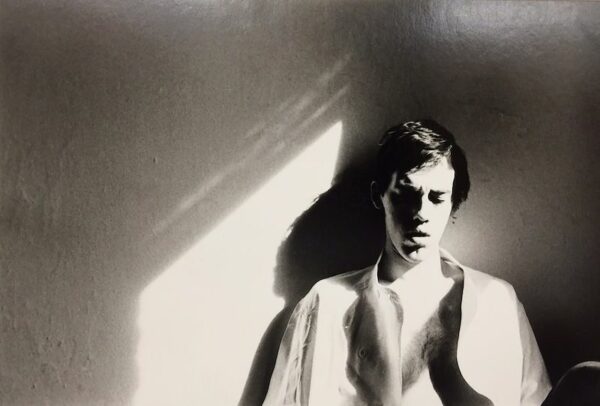
The following is Amy Scholder’s Editorial Note that appears in the 2025 reissue of David Wojnarowicz’s Memories That Smell Like Gasoline, out now from Nightboat.
When I was getting the first edition of Memories That Smell Like Gasoline ready for press in 1992, David was dying. It was our first and last book to prepare together. The other books by David that I published were posthumous. We decided to work on this one first because it felt so close to the reckonings we were having at the time. How memory has a smell and touch and feel. How it seems to change our DNA. How memorializing in words and pictures can find new meaning, keep something alive. Maybe.
I was living in San Francisco. My friend Rex Ray introduced me to Anne MacDonald, a curator and art collector who wanted to publish an imprint of books featuring contemporary art and writing. She hired me to be the editor. Memories was our first book in the series. The second book featured drawings by Nayland Blake and writings by Dennis Cooper.
David was living in a loft above the Village East movie theater on Second Avenue and 12th Street. It had been Peter Hujar’s last apartment. Anita Vitale was there when USPS delivered the finished book from the printer to David’s address. She was the best friend of Tom Rauffenbart, David’s lover; he also had AIDS. David was bedridden by then. She opened the package and showed him the book. He wasn’t speaking much at that point but communicated with his eyes as they went through the book together. When they got to the end, he wanted her to read aloud: “I am waving my hands. I am disappearing. I am disappearing but not fast enough.” And then he said, Ah. And closed his eyes.
I was so relieved to hear that he got to see it. But I wondered, does a book really matter when you’re at the end of a life cut short at the age of thirty-seven. Do you think, well, at least this will remain. I don’t know how David really felt in that moment, but I do know that he loved books and had wanted to be a published author since he was an adolescent. So maybe this book mattered to him. I’ve learned since then that it has mattered to many other people.
Just three years after that summer when the book came out and David died, a treatment for HIV/AIDS hit the market; it would keep people who had access to it alive. Tom, who thought he was going to die soon after David, was on a clinical trial for this treatment in 1994. He lived to be seventy-four years old.
A few years after another pandemic, on September 14, 2024, I sat among a few hundred people in an AIDS memorial park in the West Village to celebrate what would have been David’s 70th birthday. It was a beautiful event created by Anita, now the executor of David’s estate. I was joined by Nayland, performer John Kelly, Karen Rinaldi (editor of Close to the Knives), and a long list of artists and writers, friends and fans of David’s who read aloud from The Waterfront Journals, which I published in 1996. It was incredibly moving to hear these readings in a public square on this occasion. Afterwards, at dusk, a lot of us walked over to the Hudson River, to another AIDS memorial.
Unbeknownst to me, Anita had brought some of David’s remains (he had been cremated), which Tom had never scattered. She thought it might be a good moment to let them go, in queer community, so many people loving David.
Anita took out a few zip lock bags from her purse. She had mixed in some of Tom, too. Why not. At first, I recoiled. It was hard to feel so emotional in front of all these people—many friends and acquaintances but even more strangers. Soon though, surrounded by young people who never knew David, I became overwhelmed by other feelings. Of their love for his work, for his legacy. It seemed to me that they wanted to experience this visceral, vertiginous act of touching him—what remains— and let the ashes go into the air, hopefully into the river. Of course the wind had different ideas.
The first story in Memories, “Into the Drift and Sway,” is accompanied by watercolors that David made from memory after spending time at a porn theater. They form a diary of desire. Of memory and the ways we keep pleasure alive by imagining. That practice of David’s inspires me to do this work year after year.
I’m so grateful to Stephen Motika, Lindsey Boldt, and Rissa Hochberger at Nightboat for rescuing this book from obscurity. To Isaac Alpert, Wendy Olsoff, and Penny Pilkington at PPOW for pro- viding the artwork. And to Anita Vitale and the David Wojnarowicz Foundation for bringing forward David’s legacy so thoughtfully and with love.
Amy Scholder
Los Angeles, December 18, 2024