
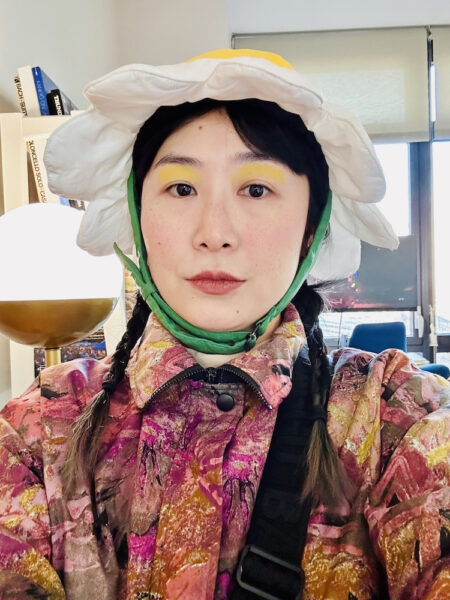
Stine An’s inventive debut poetry collection B-Dragon Suite treats translation as play, performance, and embodied sound. Across seven interlinked sections, An stages a fabulated K-pop universe to ask how language survives colonial history, migration, and spectacle without resolving into easy consumption.
Here, she discusses South Korean history and pop culture as a poetic influence, the many (infinite?) meanings of B/비, and K-pop as “katabasis pop.”
Read until the end to find out what album you should be listening to while reading B-Dragon Suite!
—Lucia Kan-Sperling
Lucia Kan-Sperling: How did the idea for B-Dragon Suite first come to you?
Stine An: I needed to develop a drag persona during my poetry MFA at Brown when I came across “C-Dragon,” a recurring character created by comedian Lee Seung-Hwan for the South Korean sketch comedy show Gag Concert. The joke was that C-Dragon would try to fill in the huge cultural gap left behind by G-Dragon during his mandatory military service, but as an off-brand version. C-Dragon, or CD, in the spirit of playful homage, would show off G-Dragon’s iconic fits and accessories improvised from household items while parodying his quirky movements and singing. I became obsessed with how a performer could use gestures and sounds as shorthand for an entire person.
G-Dragon seemed like the perfect mirror for exploring my relationship to Korean identity, language, class, and gender. We were both born in the year of the dragon, and I realized we were both lifelong performers. In G-Dragon’s case, he started performing professionally as a child actor on a popular South Korean kids’ TV show and as a member of the child K-pop group Little Roo’ra. I grew up watching him on tapes my mom picked up for me from the Korean video rental store. I saw him as a consummate symbol of South Korea’s rise as a cultural powerhouse and recognized him as someone who rarely broke from performing his larger-than-life, mythic persona. Growing up as the eldest daughter in a Korean American immigrant family within an ethnic enclave, I also saw myself as an endurance performer of various myths my entire life—the model minority myth, the myth of gender, the myth of ethnonationalism, the myth of America and the American Dream, and the myth of the immigrant success story.
The name B-Dragon also plays on a common Korean idiom I learned in Saturday Korean language school: 개천에서 용난다, “A dragon rises from the ditch.” I wanted to connect the idiom to South Korea’s rise as a global player and the trope of the immigrant success story. I am in many ways a textbook “Asian American immigrant success story,” but I wanted to explore the underbelly, the costs, and the shadow of that story.
So I invented the drag persona B-Dragon as a diasporic B-side, or shadow version, of the literal King of K-pop, to explore the minor and blue neocolonial undercurrents of Korean American life. And once I settled on the character, a whole universe opened up. I created LIL BANG, a shadow version of BIGBANG, and the Pink Blossoms, inspired by a composite of K-pop girl groups and the flattening force of South Korean gender binaries. Once I had the personae in place, I could excavate that world through the different characters. I also wanted to subvert the epic, which led me to draw ideas of both descent and dissent into the poetics. In a mirror world, K-pop also stands for katabasis pop. I wanted to go deep and play in the underworld of K-pop where the reverberations of war and militarism are ever-present and ongoing. If G-Dragon is flying high in the heavens, B-Dragon is crawling and digging in that proverbial ditch.
Lucia Kan-Sperling: B-Dragon Suite forges an entire poetic universe out of the letter “B,” or rather, the sound 비 (“bi”), using it as a kind of portal between Korean and English. What made you choose B/비 over other letters/sounds?
Stine An: I love the idea of a portal! I imagine the letters and sounds of B/비 as an enchanted ring that B-Dragon wears to create that portal between Korean and English.
The letter B/비 offered an incredibly fun and expansive constellation of sound, image, and meaning to play with and riff on.
Visually, the letter B comes from a hieroglyph depicting a house or home. A little b resembles a musical flat (♭) symbol. And this collection deals with diaspora and the idea of a suite, as a musical suite and a collection of rooms. B is also a contained or belted version of the letter D, perhaps in drag as the letter B. And the lowercase versions of d and b are almost mirrored versions of each other, but not quite. B is also shorthand for “be.”
The sound and word 비 can reference multiple meanings in Korean. It’s the word for rain, but 비 can also mean different things based on which traditional Chinese character the sound references. For example, the character 非 (비) is derived from a pair of wings turning their back or facing in opposite directions, and 飛 (비) is derived from a bird’s wings and body in flight or fall. Those two characters, along with other possible characters for 비, contained so many “minor” or “shadow” valences: flight, refusal, lowness, not-quiteness, almost-ness, failure, wrongness, being hidden, division, comparison, queen, judgment, anti-, and expense.
I loved the tension created across the different valences I could sense in B and 비. And later, B/비 also worked well visually and sonically with 빵 (ppang)—the Korean word for bread and also the sound of an explosion or a confetti popper. And of course B worked well with Bang from BigBang; Brot/Pain from Walter Benjamin’s essay “The Task of the Translator”; Birmingham, Alabama; Blue (the color and also depression, a going under); and Princess Bari, the goddess of the underworld from Korean shamanic folklore, who is hailed as Princess B in this book.
I liked that B/비, at least in B-Dragon Suite, could also be about being and not being—a call or a refusal to be that dragon that rises from the ditch. I wanted to give myself permission to remember and stay in the ditch. You don’t always have to rise above—you can also dive deeper.
B/비 functioned as a pair of runes, sounds, and concepts I could use to divine a set of poetics and images for B-Dragon Suite that could resonate with each other, in both harmony and dissonance. B-minor as a musical key and a call toward a minor literature à la Deleuze and Guattari’s essay on the works of Kafka and the deterritorialization of language. I wanted to deterritorialize B/비 from within a virtual space of diaspora where things could get glitchy. What does it mean to be a Korean American writer born in South Korea, trying to write and live in both English and Korean? What can I create that is only possible from where I am right now?
Lucia Kan-Sperling: What did your writing process look like across the many different forms present in the book (song lyrics, first-person prose, visual poems, emojis . . .)?
Stine An: I experimented a lot over the years to find my own forms, gestures, and images for this book. I drew heavily on my MFA coursework at Brown and experiences in other disciplines, including sound art and literary translation.
A sound art class with Erik DeLuca prompted me to think about sound, voice, and embodiment, particularly in relation to the Korean language and the performance of Korean identity. I thought about the queer art of failure and imperfect home songs, and what it means to long for a home that might exist only virtually. That class gave me the idea to organize the collection as a suite—both a musical suite with different movements and a suite of rooms you can move through in a different order. I wanted the sounds of the poems in this collection to carry across the rooms.
Sawako Nakayasu’s poetry and literary translation workshops introduced experimental translation as a generative technique, allowing me to compose poems through mistranslation (or hyper-personalized translation), sonic slips, and accumulation rather than a faithful, or correct translation. Sawako also introduced me to Don Mee Choi’s essay Translation is a Mode=Translation is an Anti-neocolonial Mode, which made me consider for the first time the neocolonial relationship between Korean and English.
That’s when I started doing both “normal” translations of South Korean poetry and experimental translations of cultural artifacts from my life.
I generated experimental translations of BIGBANG songs as a speculative listening exercise. What if I misheard and warped the lyrics based on my experiences as a Korean American neocolonial subject in the diaspora? What does it mean when a love song about longing becomes a song about conditional belonging? What if the singer of the song wasn’t a boyfriend figure, but a nation calling out for my gendered labor? Listening to BIGBANG’s songs about farewells and longing, I started hearing them differently—as songs about a country as a toxic boyfriend, as songs about conditional acceptance and belonging based on your value as a representative of a nation-state. You’re only wanted if you’re useful, if you return, if you perform your role correctly. That felt deeply connected to my diaspora experience, where I’ve always had to perform exceptionally to be recognized as a real person—performing as a Korean American for both Americans and Koreans.
I started translating Korean poetry to stay connected to the language and learn about contemporary South Korean culture. I became interested in K-pop and K-dramas as sites where you can see ideology at work: gender, nationalism, and desire encoded and proliferated in pop lyrics, narratives, and images. I also became interested in learning more about the experiences of young women in South Korea through protest movements like the 4B movement (where the B stands in for 비 as in refusal or “no”). I wanted to understand how my experiences of being socialized as a Korean woman or eldest daughter in the States intersected with the experiences of contemporaries in South Korea.
I let myself create form intuitively based on the conceptual idea I wanted to explore and the content of the poem—thinking of form as a container. The forms came from what each piece needed and how the pieces conversed with each other. Some wanted to be sung, some wanted to be seen on the page, some wanted to exist as a sound exercise or gesture. For example, “Bereavement Table for a Top Model Imagined” is a series of experimental translations of the trophy text from all the awards I received while attending Saturday Korean language school and Sunday school in my Korean immigrant community, exploring the idea of placement. Each mini-poem or translation in the piece is designed to evoke both trophy and tombstone.
Later, I developed the undercurrents around Princess Bari, the abandoned princess from Korean shamanic folklore who must descend into the underworld to save her family. I was inspired by Don Mee Choi’s translations of Princess Abandoned, in which Kim Hyesoon traces the lineage of Korean women’s literature to shaman-songs. I connected Princess Bari’s plight with the plight of daughters being asked to perform and sacrifice for a family, nation, or society that doesn’t fully see you.
Lucia Kan-Sperling: You recently co-authored a piece for Lit Hub that paired contemporary Korean poetry collections with Korean music albums. Do you listen to music while writing? What album would you pair with B-Dragon Suite?
Stine An: I often listen to music for material and inspiration.
If I had to pair the book with one album, it would be G-Dragon’s eponymous EP Kwon Ji Yong. The album is titled with G-Dragon’s civilian name. It came out around the time he turned 30, and the album has explicit nods to Dante’s The Divine Comedy. This made me think about the existence of a K-pop inferno, and I read the album as a global pop star contemplating middle age and over 25 years of performance trying to be real and introduce himself as a person and not just a persona. I fell in love with the idiosyncrasies of his voice and innovative sound. I especially love the language- and voice-bending on this particular album.
Lucia Kan-Sperling: Are you a V.I.P.¹?
Stine An: I honestly wasn’t a fan of BIGBANG or G-Dragon when I started writing this book. I knew they existed. But after writing this whole poetry manuscript, now I think I am. I recently saw them at MetLife Stadium, and it was a really special experience. It was my first time seeing a K-pop boy band in concert, and only my second stadium concert ever. My first was seeing the K-pop girl group TWICE, and it made me imagine a poetry concert with similar production value where all the fans were reciting a poet’s verses by heart. It felt so strange and exhilarating to see BIGBANG perform the songs I’d refracted through experimental translation for this collection and to see them embodied through their voices, gestures, and connection with the audience. I even bought a special G-Dragon Daisy lightstick to wave during the concert. But does owning a lightstick and going to one concert actually make me a V.I.P. and true member of BIGBANG fandom? Is this entire poetry collection just fan art, stan poetry about G-Dragon?
There’s only one way to find out—get your copy of B-Dragon Suite ;o)
¹ BIGBANG’s fandom name.