
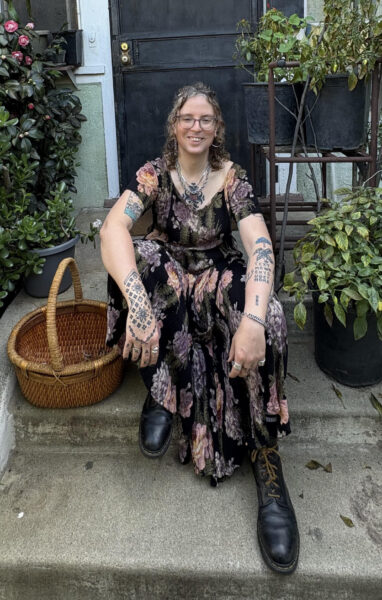
imogen smith’s evanescent second collection raw & zero enters the world “in an epoch of pandemic, genocide, mass war, poverty, corruption, & environmental destruction,” yet “in the center there is / hope,” steamy, sexy blossoms of hope. smith’s prosodic virtuosity and visual poetics bring the reader into her world of herbalist gardens, political organizing, and protest, without letting you forget “How would i love you if i didn’t love your pleasures?”
—Lina Bergamini & Stephen Motika
Lina Bergamini & Stephen Motika: You say, “raw & zero entered the world in an epoch of pandemic, genocide, mass war, poverty, corruption, & environmental destruction.” How do you write into pain? How does pain show up in your work? What is your work’s relationship to grief?
imogen smith: It’s clear now—& should have been clear for the past, say, 500 years—that one’s relationship to grief depends on one’s capacity to hold life sacred (your own & everything else’s) & believe whole-heartedly in justice, community, land connection, etc. Because i strive to live my life with these forms of love & belief held paramount, my work’s relationship to grief is total. i’ve seen so many artists—especially fellow white artists—shy away from the kind of immersion in the world that love & justice demand of us. To live an honest life is to have an intimate relationship with grief, to be willing & able to recognize it, name it, scream about it incessantly, learn from it, rage against it. At the same time, grief keeps us engaged with the world (of people, beings, ideas, etc.) through its mandate to remain present.
i’m working on a long poem that’s guiding light is existing within “a communism of thought,” & i likewise want a communism of grief, by which i mean we hold the material that is grief together, confront it together, critique & reflect, together.
As an individual writer, the notion of writing into pain feels complex. i’m trying to respond in & with language to the time, with all the honesty, clarity, & creative ingenuity that i can bring to the page. Pain weaves its way in & out. There’s always a throughline of it—because genocide, pandemic, everything listed—but it isn’t always on the forefront of my aesthetic mind (the poem “collector” being an exception to that—i was grieving a relationship & certain elements of my sociality in that one). But think about it: walking through the world, one witnesses grief everywhere. Take New York City for example, its wild asymmetries of power & access, its erasures, or really anywhere in this country as a whole: every square inch is site of & witness to the most incredible violence ever wrought. To be present is to write into grief & pain, to say little of simply walking to the train or something.
Pain is. Grief is. You could ignore it, but you’d have to really close yourself off to do so, or live completely detached from the world around you, which, incidentally, would make one an inconsequential artist. i think the challenge is to offer something generative out of all the pain & grief, through the work.
Lina Bergamini & Stephen Motika: Talk more about what you mean by, “how would i love you if i didn’t love your pleasures?”
imogen smith: With this line (& specific page/section of “mutual pleasure mutual” from which it comes), i’m gesturing towards non-monogamy in romantic relationships. i’m a person who is really striving in my life to unlearn monogamy, which itself gestures towards ownership of people—& the transformation of people into commodities—as a whole. Take friendship as a template: one’s community of friends is never homogenous. You don’t seek out the same friend for every situation, every day in sun & rain, for every reading or party. The spectrum of human emotion & need is simply too vast for that to even be conceivable. The same is true with lovers, & anyway, i am trying with my life to transform my practice of romantic love into another modality of friendship, which, for me, begins here, in the language i can conjure to listen to or teach or assure myself. So the goal, for me, is to always lead with this sentiment: “how would i love you if i didn’t love your pleasures?” because another’s pleasures are sacred, & also necessarily will vary in relation to my own (which, in any case, aren’t static). Incidentally, this seems like a good question to ask across the spectrum of one’s relationships.
In saying this, i don’t want to intellectualize it too much. Personally, i have a lot of trouble & a varied track record when it comes to this unlearning (never the most liberated girl in the room), & to being totally okay with however others respond to said sentiment. Sometimes i can do it; always, it’s aspirational. But love is vast, its limits fluid, & so we commit to learning ourselves & each other through our interactions, our pleasures, desires, & negotiations thereof, striving to feel more & more & more of what it may be humanly possible to the human.
Lina Bergamini & Stephen Motika: You say, “& i am / nothing / if not / a girl / who loves / Love.” To what extent would you say these are love poems versus sex poems? What is the line between love and lust? Where does love and lust intertwine with the global situation which these poems were written in?
imogen smith: Good question—they walk a thin line! i’m in love with all the people i care about, whatever classification of association they might fall into (were one into classifying relationships, which i’m not). Like everyone, i strive at “love,” mostly failing, succumbing to my own paranoias, cruel internal voices, habits & inhibitions, modes of avoidance, etc. Love, broadly speaking, is truly the beating heart of one’s forever work. To the extent that these poems are sex poems, i think it’s less to do with “sex” than it is to do with learning & understanding one’s desires—what to ask for, the physical collaboration, etc. Something my own dysphoria/morphia—& being a transsexual in general—has taught me is that it is hard to love (& here i mean love in the generally accepted sense, but also fucking, getting fucked, expressing, befriending, rioting, & so on) when you hate yourself, or find yourself (pejoratively) monstrous. So there’s a meta level in which the distinction between a love poem & a sex poem can potentially collapse, where i might’ve been thinking one thing while composing, but the reader can feel another.
That line between love & lust is confusing, maneuvering the parasocial world of social media, of city streets, locking eyes on the train, of readings & parties & what-have-you. It’s easy to fool oneself into believing that connections might mean more—or less—than they actually do, as so much of our communication is online (which is totally fine, but also lacking in a certain kind of face-to-face witnessing, even on just a gestural level). i think lust can be part of love, & love can be shot through with lust, that perhaps there’s a sweet spot of lusting that’s really healthy, keeps you moving, yearning towards—. Come to think of it, i actually love to lust, & the trick of it is to always be able to step back from it & have some reflexive analysis because, of course, lust can destroy you. But again, it can also keep you growing, keep you in motion, lead you to new forms of embodiment & language.
It may sound totally naive, but to the question of love & lust intertwining within the global contexts in which raw & zero took shape, i think it’s clear enough to say that i love life, i love people, i love creation, & i fucking lust, i fucking YEARN for justice, for the inherent right of all beings to self determination, for repair & healing & building & dreaming. For community & comradeship. i’m hot for this, if i’m hot for anything.
i also think we’d be kidding ourselves (& betraying our queer forebears) if we didn’t think about the erotics of the demonstration, the march, the riot. Those are sites where people come together, witness one another, forge networks, place their bodies in both love & harm’s way(s). Protests & direct actions have likewise deepened my relationships—i think the last few years of trying to survive personally, & also struggling in the ways i can for the survival of others, has been really illuminating: i know who to trust & how far, how to trust in different ways, different contexts. Any charged space is going to manifest lust (as we’ve been talking about it here), & anyway, to love humans & believe in justice is to do just that. Every riot against the state is a poem of love & lust.
Lina Bergamini & Stephen Motika: You’ve spoken about the influence of N. H. Pritchard and other visual poets. Will you talk a bit about how their work has shaped your poetics in raw & zero?
imogen smith: For me, starting a new project entails dreaming my poetics up again, from the ways i work to my relationship with language itself. A new project means a new language, in a sense. stemmy things used up all the material i had—with one’s first book, or really any book, you have to be aware that you may not have the opportunity to do another—so i just laid it all out in a consciously maximalist way. i was then liberated from all that language, having nothing in terms of new work—only burgeoning influences & possibilities.
Two things happened in the winter of 2022/2023: i was selected as an Emerge-Surface-Be fellow at the Poetry Project, & i got really into concrete poetry. N.H. Pritchard was opening my mind up to language’s more arbitrary, but nevertheless material, thus political, properties. A $7 copy of Alex Balgiu & Mónica de la Torre’s Women in Concrete Poetry 1959–1979 became one of those books you carry around wherever you go, just to have its energy present—i mean i was (& still am) obsessed! Nightboat’s own Eduardo Kac collection Porneia was also huge. At any rate, these books introduced me to work that was so far beyond whatever i’d been looking at, coming out of an MFA program, & my entire conception of how i wanted work to sit on the page underwent a major transformation.
At the time, all i had was a 2012 laptop, so technology was limited. Writing in Google Docs, there’s only so much one can do, design wise, so i used the tools i had & took the influence of concrete poetry as a broad field & applied it to some of the new pieces i was working up, under the tutelage of Stacy Szymaszek in the ESB fellowship. i strove for intentionality on the page—how words landed & where, & what the negative space could do to augment or present whole new elements of meaning to the language itself. Form, emptiness, those are languages, too. The middle section of raw & zero is where most of these emergent pieces ended up.
Take the recurrent symbol that stands in for “God” throughout the book—sometimes it’s complete, other times, missing elements. i didn’t want to overuse this already overstuffed word (God), so transforming that “god thought” into an unpronounceable symbol that conveyed a wholeness—or lack thereof—felt precise.
It’d definitely be a stretch to call anything in raw & zero concrete poetry (that’s something i’d like to experiment with more, technology providing!). But that influence is certainly there, & helped me find a greater concision/precision of language, as well as clarifying the beats & rhythms of the pieces. So the book feels quite inspired by, yet unbeholden too, concrete poetry.
Lina Bergamini & Stephen Motika: In “Abiquiu” you write of your visit to Dar al Islam and meeting with their Imam, who offered the advice: “remember God every day.” Can you talk about how your spiritual practice coincides with your poetic practice?
imogen smith: What i love about it, & what draws me to Islam as a practice, is that while it certainly is esoteric & deeply intellectual, it is also very simple in (what i believe) its aim is in the material world: how do we, who understand so little in the scheme of things (that scheme being God/creation), move through the world with an attentiveness that illuminates ways to nurture justice in our communities. That’s it, & in the Qur’an itself, God is always saying something to the effect of “let those who can see, see,” or “the signs are obvious to anyone who pays attention,” which means that spirituality is at once a material, spiritual, and intellectual praxis.
I’ve had a lifelong fascination with Islam, almost reverting many times throughout the last twenty-five years. Witnessing Palestinian & SWANA centered, diasporic leadership within social movements i’m part of, not to mention the tremendous humanity of the Palestinian people, certainly infused my preexisting desire for this particular ritualistic & communal praxis of the sacred. It was, in many ways, the missing thread tying disparate yearnings together.
Poetry is my way of witnessing the world, of learning & knowing myself, of deeply engaging, both intellectually & aesthetically, with language, & of finally giving back what i can for the privilege of witnessing. It stands to reason that my spiritual & artistic practices would strive for coherency within that.
Islam asks that we strive to make a just Ummah, & beyond that, a just world. Justice & Mercy are its heart & soul. i hope that my poetry engages the world with these same yearnings & graces in mind. If my proverbial eyes are open, they see a world in which human beings are gravely sick. If i am striving for love in all the queer senses we’ve been talking about, then i have to respond to what i see. i’d like to think this repetitious way of being is present in all my work, pre & post reverting, & if anything, Islam has offered me a more soulful framework within which to ground my heart that was present in my art to begin with.
That advice the Imam gave me—remember God everyday—obviously means to reflect on God, but likewise to be present in the here & now, the material world. In remembering God everyday, i can nurture myself as a spiritual being, a person in community & context, & as a poet, for to remember God is, in some very major way, to be awake to the world around you. For me, that’s where poems come from.