
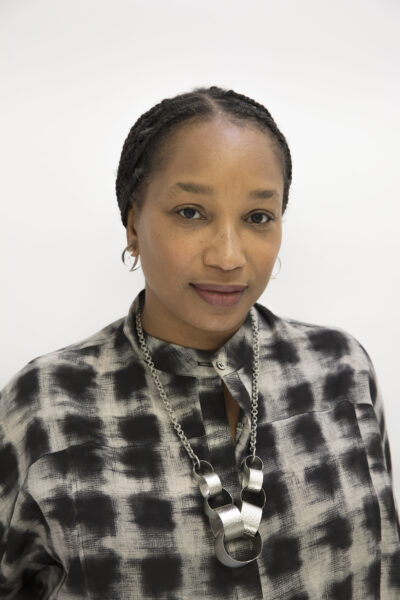
In Residual, Tisa Bryant weaves together memories, scenes from the life of her late mother, and her own research into the lives of other Black women writers and artists into an intimate hybrid memoir. Central to the work is the relation between grief and the archive, and the way the latter can act as “a site of Black life and afterlife, presence being asserted, reframed, affirmed.”
In this conversation, we discuss “spiral retelling,” the many definitions of “residue,” and how writing can inhabit a “death-bent sense of time.”
—Lucia Kan-Sperling
Lucia Kan-Sperling: The title Residual points both to a surplus and a lack, something that has slipped through the gaps of a certain process or system. Could you talk about how this book took shape over years of writing and working? How did the themes of loss and archival research emerge as central?
Tisa Bryant: When I write, I often start with a title as a conceptual frame or snapshot of a feeling. When my mother died, I was overcome with the sense of something held over, held back, left behind or left over. The entirety of one’s world is rearranged by the death of a beloved: time, texture, relation, matter, by which I mean both the stuff of life and life’s significance. At the earliest inklings of this book, I was working with the word “abeyance.” I always intended the writing to emerge on two narrative planes. The first concerned a revisiting and a reworking of unfinished projects, the research on my Barbadian genealogy, or on Lorraine Hansberry, but had yet to synthesize into the tangible thing I had planned for each. Over time, these projects, the files and books and notes, became the mark and measure of my grief, depression, and so “abeyance” was in keeping with my deferral and my emotions. I thought I could gather my research presentations and notes into something readable and performative and weave my thoughts and feelings about mother around it all, but it didn’t work; I wasn’t really there, with all my messy feelings. The second plane I intended to write towards was that: my feelings about my mother’s death, which I thought I could work with critically, as with source material. I would simply deploy one of the many verby or bodily metaphors: weave, thread, connective tissues, neural networks of memory and sensation. But an emotion like grief is unwieldy, vaporous, sudden, not so easily corralled. A residue. I’m sure I liked the word “abeyance” also for its elegant expression of control, and I know I disliked it for its homophonic relation to “obey” and “obeisance.” The main problem with the “abeyance” as conceptual frame for this work was not the research-as-writing-pause. It was the grief and longing itself, in my actual life, mirrored in the archive. Black women died prematurely under my close reading and researching eye, as my mother died prematurely, and that was in excess and simultaneously lacking from my pen. One day I asked myself, “what am I left with?” and the answer was “a life without my mother,” which was a life I didn’t want but the life I had, a life in which I could no longer talk directly to her in person, by phone or email. I had to look at, touch, review, weigh and recall my life with and without my mother, and its death-bent sense of time, and find the words, accept the words, that could attend to that life, which is this life. I had to discover what might be left for me to do with writing in the process, what writing can be for me now.
Lucia Kan-Sperling: The many pieces that comprise Residual are linked not only by subject matter but by form; for example, certain sections share the same title and are grouped together in the book’s table of contents. Could you tell me more about this book’s structure? How did Édouard Glissant’s concept of “spiral retelling” influence your thinking?
Tisa Bryant: I found definitions of “residual” from various dictionaries helpful in organizing feeling and thought, memories, scenes and situations, and chose to reuse them in certain instances. For example, the first instance of the section header, “an internal aftereffect of experience or activity that influences future behavior,” presents the experience of writing my mother’s life story as funeral program. It is indexical, ekphrastic, and in a sense has become an archival artifact of her life. The second instance of this section header concerns Octavia E. Butler, Lorraine Hansberry, and archival research, and how I have carried with me as artifact the experience of having been close to them, vis-à-vis their papers, words, dreams, as literary mothers and models. The “aftereffect of experience influencing future behavior” flows through both sections. There is a similar associative gesture among the repeating section headers, though the section headers, whether “a rocky portion of high ground after erosion,” “of or constituting a residue,” or “a corrected value after error,” are nuanced iterations of the same generative dynamic of cause and effect, give and get, life and death, and work to hone “residual” as a narrative framework overall. I also like how the Table of Contents loosely mimics a handlist or finding aid for an archival collection.
Lucia Kan-Sperling: This book combines multiple literary genres, including criticism, memoir, and lyric. What different conceptual and/or emotional registers are you able to access via these different modes? Do you see them as conceptually distinct from one another or as intersecting methods in a unified process of inquiry?
Tisa Bryant: I’d like to think about Édouard Glissant and “spiral retelling” here, and consider genres, modes and registers alongside or even as a geography and topography, as ways to understand how we arrive imaginatively at the materiality of place through language, time and relation. Max Hantel, in his article, “Rhizomes and the Space of Translation: On Édouard Glissant’s Spiral Retelling,”¹ says “The practice of translation helpfully encapsulates this relationship, intertwining the linguistic transition between languages with the spatial residue of its etymological meaning, to carry across.” While monolingual on its surface, Residual moves in these ways, carrying word across media and feeling, through time, and again, reaching across states of mind and planes of being. Criticism gives me a long focal lens, or an aerial view; the lyric, litany, prayer, spirit, as close as I was able. The ekphrastic cinema pieces combine the critical and the lyrical to translate image and trace these geographies of language, culture, literature, film, as they come from particular people, specific places and tongues. These are intuitive and contextual modes for getting near this one part of the enormous story of my relationship with my mother, how her grandmother shaped her mother, shaped her, shaped me, the stories told and untold of our line. There are audible traces of French and Spanish and other languages on the Caribbean side of my family, lingual presences my grandmother simply explained as movement: for work, for love, for escape, for secret things that were kept quiet, that were not for me to know. I don’t speak the language of the ancestors, but I feel it. I write in English, and that’s what I hear when they speak to me (in italics, on the page, at least). It’s important for me to note that “spiral retelling” was first related to my writing by poet Stacy Szymaszek, in her review of Unexplained Presence for the Poetry Project Newsletter. At the time, I had read parts of Édouard Glissant’s Poetics of Relation. When I heard the phrase “spiral retelling,” I saw it in my mind and understood it in my body rather organically, and was glad for the clarity it gave me, and the compliment! In relation, I immediately thought of two writers: Gayl Jones, and M. NourbeSe Philip, and the impact of their writing and thinking on my own. In this way, places I’ve been, Massachusetts, New York, California, Iowa, Barbados, and places I’ve never been, Panama, St. Lucia, Toronto, Trinidad & Tobago, Martinique, Cuba, Haiti, move through Residual in obvious and quiet ways, (re)creating place, history, belonging and connection through movement and inquiry.
Lucia Kan-Sperling: At one point in the book, you describe an encounter with Lorraine Hansberry’s personal archival materials as a portal to imagining her “at her home,” “at her typewriter table,” and “walking through her kitchen . . .” How do Hansberry and other Black women writers and artists appear as sites of imagination and mourning in this book? What is the importance of the domestic space in your investigation of the archive?
Tisa Bryant: The domestic space emerged over the course of writing Residual in a way that overshadowed the archive because I realized, for the writing and thinking at hand, that domestic spaces precede the archive. They have to. Archives come from living and the living, from our houses and habits, out of shoe boxes and bundles and wrapped with thick ribbon, from briefcases and desk drawers, as noted in the finding aid for Lorraine Hansberry’s papers. They don’t just appear like mushrooms growing through the floor of academic institutions. They come out of somebody’s home. The plantation ledger of sugar, fabric, people, the slave owner’s meticulous journal of daily atrocities, letters to friends, drafts of stories and poems, diaries, commonplace books, scraps of paper with a grocery list on one side and a snatch of dialogue for a future sci-fi novel (Octavia E. Butler) on the other. Archives are not only the residual of death but the continuance of life, in a sense, as we inhabit that life with this particular research, into the personal papers, public works and ephemera of writers and artists. In Residual, I imagine what our homelife might have been like had my mother actually pursued the writing career she is fabled by some in my family to have wanted. Writing Residual, being immersed in thoughts of home, “a room of one’s own” for Black women writers and artists, was indeed a central preoccupation, and at the same time, there was an active mourning, and reactivated grief. My siblings and I were negotiating care for my dad, who developed dementia in the years after my mother’s death. The house he built with my mother was in disarray as well, forgetting itself, forgetting us. These losses, of my dad, of our family home, were in progress as I wrote, reactivating unprocessed grief. As I wrote, Black women were being murdered in their homes, by police, by spouses, partners, exes, or being barred from the security of home due to mental health or unaffordable housing, or all these things at once. The solidity and precarity of Black women at home are in tension throughout Residual, and have been in tension since my great-grandmother’s marriage broke down the family home and she took her daughters away from Barbados and immigrated to the US. Memory is this archive more than anything else, and it is, of course, faulty. This conjure work in Residual, then, juxtaposes these states of precarity and possibility among Black women writers, artists, friends, strangers, sisters. This too is the geography, the landscape and the language we speak.
¹ small axe 42, November 2013, Duke University Press.